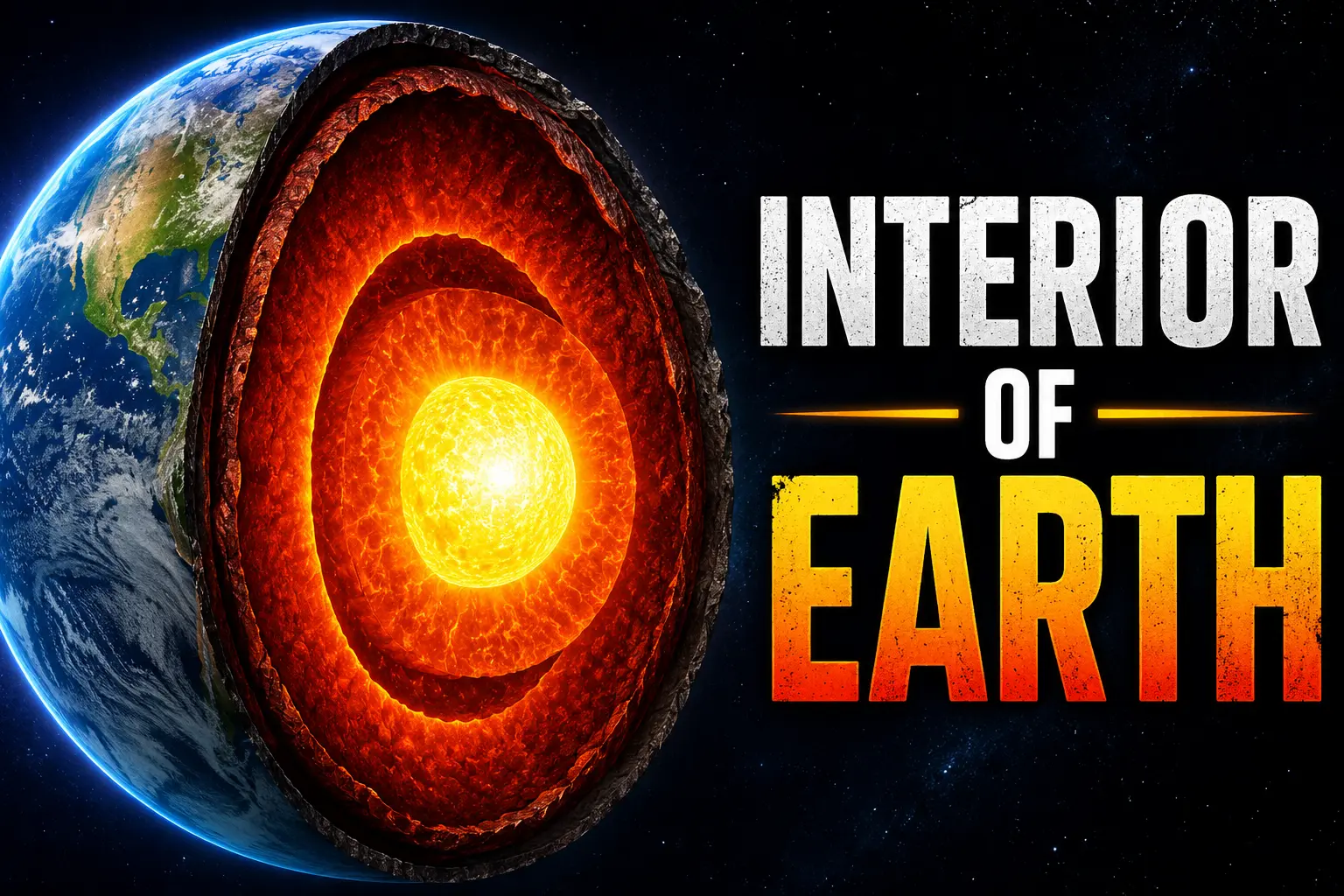
The interior of the Earth is one of the most important topics in physical geography because it explains the hidden structure that drives earthquakes, volcanoes, mountain building, plate movement, and the Earth’s magnetic field. For UPSC aspirants, this topic is valuable because it appears in both Prelims and Mains and connects with several other chapters such as plate tectonics, geomorphology, and natural hazards.
Earth is not a uniform solid sphere. It is a layered planet, and each layer has different composition, density, temperature, and physical behavior. The deeper we go, the greater the pressure and heat become. This layered structure formed early in Earth’s history when heavier materials sank toward the center and lighter materials stayed near the surface.
Why the topic matters
The Earth’s interior is important because it is the source of internal energy. That energy powers tectonic motion, volcanic activity, seismic events, and magnetic field generation. Without these internal processes, Earth would be geologically inactive.
For UPSC, this topic is useful because it links to multiple areas of the syllabus. In GS Paper 1, it supports physical geography. In GS Paper 3, it connects indirectly to disaster management and natural hazards. In answer writing, it allows you to use diagrams, scientific terms, and cause-effect logic in a clear way.
How scientists study the interior
Humans cannot directly observe the Earth’s deepest layers, so scientists depend on indirect evidence. The most important source is seismic waves generated by earthquakes. These waves travel through the Earth and behave differently depending on the material they pass through. By studying their speed, direction, and disappearance, scientists can infer the structure of the hidden layers.
Other sources include volcanic rocks, meteorites, gravity measurements, heat flow studies, and laboratory experiments under extreme pressure and temperature. These do not provide a direct view of the Earth’s center, but together they create a reliable scientific picture.
Main layers of Earth
The Earth is usually described through three major compositional layers: crust, mantle, and core.
| Layer | Approximate depth | Physical state | Main composition | Key feature |
|---|---|---|---|---|
| Crust | 5 to 70 km | Solid and brittle | Silica and aluminium in continental areas; silica and magnesium in oceanic areas | Thinnest layer; broken into plates |
| Mantle | 70 to 2,900 km | Mostly solid, ductile in parts | Silicate rocks rich in iron and magnesium | Thickest layer; convection occurs here |
| Outer core | 2,900 to 5,150 km | Liquid | Iron and nickel | Generates Earth’s magnetic field |
| Inner core | 5,150 to 6,371 km | Solid | Iron and nickel | Solid because of immense pressure |
Crust
The crust is the outermost and thinnest layer of the Earth. It is the part on which continents, oceans, and human life exist. Though thin, it is very important because all surface geological processes happen here.
There are two main types of crust. Continental crust is thicker, lighter, and mainly granitic in composition. Oceanic crust is thinner, denser, and mostly basaltic. This difference in density is one reason why oceanic plates often subduct beneath continental plates.
The crust is brittle and divided into tectonic plates. These plates move slowly over the mantle and create earthquakes, volcanic belts, mountain ranges, and ocean ridges. For UPSC, it is important to remember that the crust is not just a surface layer; it is the most active zone in terms of visible geological events.
Mantle
The mantle lies below the crust and extends to a depth of about 2,900 km. It makes up the largest part of the Earth by volume. It is composed mainly of silicate rocks rich in iron and magnesium.
Although the mantle is solid, it behaves in a plastic way over long periods. The upper mantle contains the asthenosphere, a weaker zone that allows the rigid lithospheric plates above it to move. This is one of the most important ideas in plate tectonics.
The mantle is also the main zone of heat transfer inside the Earth. Heat moves slowly through convection currents. These currents are one of the main forces behind plate movement and help explain volcanism and surface deformation.
Core
The core is the innermost part of the Earth and is mainly made of iron and nickel. It is divided into two parts: the outer core and the inner core. The core is much denser than the crust or mantle and is central to Earth’s internal heat and magnetic behavior.
Outer core
The outer core lies beneath the mantle and is in a liquid state. This is one of the most important facts to remember for exams. It contains molten iron and nickel and may also include lighter elements.
The movement of this liquid metal creates electric currents, which generate the Earth’s magnetic field. This process is called the geodynamo. The magnetic field protects Earth from harmful solar particles and supports life on the surface.
Inner core
The inner core is the deepest layer and is solid, even though temperatures are extremely high. It remains solid because the pressure at the center of the Earth is enormous.
It is believed to be made mainly of iron and nickel. Since it cannot be observed directly, its nature is understood from seismic evidence and scientific models. For UPSC, the key point is simple: the inner core is solid due to extreme pressure.
Physical divisions
Earth is also classified according to physical behavior. This helps explain how different layers respond to pressure and stress.
Lithosphere
The lithosphere includes the crust and the uppermost rigid part of the mantle. It is broken into tectonic plates that move slowly over the surface. These plates are responsible for earthquakes, mountain building, volcanoes, and seafloor spreading.
Asthenosphere
Below the lithosphere lies the asthenosphere. It is a weak, ductile zone of the upper mantle. It is not fully liquid, but it can flow slowly enough to allow the plates above it to move.
Mesosphere
The lower mantle is sometimes called the mesosphere. It is stronger and more rigid than the asthenosphere because pressure is much higher. Even so, it can still deform slowly over geological time.
Outer and inner core
These are also physical divisions because they differ in state. The outer core is liquid, while the inner core is solid. This difference is critical for seismic wave behavior and magnetic field generation.
Discontinuities in Earth
Discontinuities are boundaries where seismic wave speed and material properties change sharply. These boundaries are very useful in studying the Earth’s hidden structure.
Major boundaries
- Moho — separates crust from mantle.
- Gutenberg — separates mantle from outer core.
- Lehmann — separates outer core from inner core.
Full mnemonic
Prelims Mnemonic: “Can Men Read Good Letters?”
- Conrad — separates outer crust from inner crust.
- Moho — separates crust from mantle.
- Repetti — separates upper mantle from lower mantle.
- Gutenberg — separates mantle from outer core.
- Lehmann — separates outer core from inner core.
This full sequence is useful because UPSC may ask both the major and minor discontinuities.
Seismic waves
Seismic waves are the most important scientific evidence for Earth’s internal structure. They are produced by earthquakes and travel through the Earth in different ways.
There are two main body waves: P-waves and S-waves.
P-waves are faster and can travel through solids, liquids, and gases. They are compressional waves. S-waves are slower and can travel only through solids. They cannot pass through liquids.
This difference is extremely important. Since S-waves do not travel through the outer core, scientists concluded that the outer core must be liquid. Seismic shadow zones also support this conclusion and help map the Earth’s internal boundaries.
Temperature, pressure, and density
As depth increases, temperature, pressure, and density all increase. This is one of the most basic and important patterns in Earth science. The deeper layers are hotter because of leftover heat from Earth’s formation and radioactive decay inside the planet.
Pressure increases because of the weight of the overlying layers. Density increases because heavier materials are concentrated toward the center. This is why the Earth is layered, with lighter material outside and heavier metallic material inside.
The inner core remains solid because the pressure is so strong that it prevents complete melting, even at very high temperatures.
Importance of Earth’s interior
The Earth’s interior is directly connected to many surface processes. Earthquakes occur because of stress release along faults or plate boundaries. Volcanoes happen when heat from inside the Earth produces magma that reaches the surface. Mountain building occurs when plates collide and compress crustal material upward. The magnetic field is produced by the movement of liquid iron in the outer core.
So, when we study the interior of the Earth, we are really studying the forces that make the Earth active and dynamic.
UPSC prelims focus
For Prelims, these are the most useful facts:
- The crust is the thinnest layer.
- The mantle is the thickest layer.
- The outer core is liquid.
- The inner core is solid.
- S-waves cannot travel through liquids.
- The Moho separates crust and mantle.
- Gutenberg separates mantle and outer core.
- Lehmann separates outer core and inner core.
Questions are often asked in statement form, so understanding the logic behind these facts is more useful than simple memorization.
UPSC mains focus
For Mains, you should go beyond definitions. Explain how the Earth’s interior affects tectonics, earthquakes, volcanism, and the magnetic field. Also mention how seismic waves helped scientists discover the internal layers.
A good answer should include a neat labelled diagram, a comparison between chemical and physical divisions, one or two examples of internal energy affecting surface processes, and a conclusion showing why the Earth is a dynamic planet.
Common exam traps
Students often confuse the outer core and inner core. Remember that the outer core is liquid and the inner core is solid. Another common mistake is thinking that the mantle is fully molten. It is not. Most of the mantle is solid, though it can flow slowly over time.
Another trap is mixing up P-waves and S-waves. P-waves move through solids and liquids, while S-waves move only through solids. This is one of the most important distinctions in the chapter.
Conclusion
The interior of the Earth is a layered system made up of the crust, mantle, outer core, and inner core. Each layer has a different composition, state, and role. The crust supports life, the mantle drives convection and plate movement, the outer core generates the magnetic field, and the inner core remains solid under extreme pressure.
This topic is highly relevant for UPSC because it connects physical geography with earthquakes, volcanoes, plate tectonics, and Earth’s magnetic behavior. A clear understanding of the Earth’s interior gives you a strong foundation for both Prelims and Mains.
If you remember only three things, remember these: the Earth is layered, seismic waves reveal those layers, and internal heat powers the planet’s major geological processes.
UPSC Previous Year Questions on Interior of the Earth
Question 1
Consider the following statements:
- P-waves are recorded earlier than S-waves in a seismograph.
- P-waves travel through solids, liquids and gases, whereas S-waves travel only through solids.
Which of the statements given above is/are correct?
(a) 1 only
(b) 2 only
(c) Both 1 and 2
(d) Neither 1 nor 2
Answer: (c) Both 1 and 2
Explanation: P-waves are faster than S-waves and can travel through all three states of matter, while S-waves can travel only through solids .
Question 2
With reference to the interior of the Earth, consider the following statements:
- The outer core is in liquid state while the inner core is in solid state.
- The lithosphere includes the crust and the uppermost part of the mantle.
- The oceanic crust is thicker than the continental crust.
Which of the statements given above is/are correct?
(a) 1 and 2 only
(b) 2 and 3 only
(c) 1 and 3 only
(d) 1, 2 and 3
Answer: (a) 1 and 2 only
Explanation: The outer core is liquid and the inner core is solid. The lithosphere comprises the crust and the uppermost mantle. Oceanic crust is thinner, not thicker, than continental crust.
Question 3
Which of the following seismic waves are the fastest and can travel through both solids and liquids inside the Earth?
(a) S-waves
(b) Love waves
(c) P-waves
(d) Rayleigh waves
Answer: (c) P-waves
Explanation: P-waves are primary waves and are faster than S-waves. They can travel through solids, liquids and gases.
Question 4
The boundary between the crust and the mantle is known as:
(a) Gutenberg discontinuity
(b) Lehmann discontinuity
(c) Moho discontinuity
(d) Repetti discontinuity
Answer: (c) Moho discontinuity
Explanation: The Mohorovičić discontinuity, or Moho, separates the crust from the mantle .
Question 5
The boundary between the mantle and the outer core is called:
(a) Moho discontinuity
(b) Gutenberg discontinuity
(c) Lehmann discontinuity
(d) Conrad discontinuity
Answer: (b) Gutenberg discontinuity
Explanation: Gutenberg discontinuity marks the boundary between the mantle and the liquid outer core.
Question 6
The boundary between the outer core and the inner core is called:
(a) Conrad discontinuity
(b) Repetti discontinuity
(c) Lehmann discontinuity
(d) Moho discontinuity
Answer: (c) Lehmann discontinuity
Explanation: Lehmann discontinuity separates the liquid outer core from the solid inner core .
Question 7
Which of the following statements about seismic waves is correct?
- P-waves are compressional waves.
- S-waves are transverse waves.
- S-waves can travel through liquids.
Choose the correct answer:
(a) 1 and 2 only
(b) 2 and 3 only
(c) 1 and 3 only
(d) 1, 2 and 3
Answer: (a) 1 and 2 only
Explanation: P-waves are compressional, S-waves are transverse, and S-waves cannot travel through liquids.
Question 8
Which layer of the Earth is responsible for the generation of the magnetic field?
(a) Crust
(b) Mantle
(c) Inner core
(d) Outer core
Answer: (d) Outer core
Explanation: The motion of molten iron and nickel in the outer core generates the Earth’s magnetic field .
Question 9
Consider the following statements:
- The mantle is the thickest layer of the Earth.
- The crust is the thinnest layer of the Earth.
Which of the statements given above is/are correct?
(a) 1 only
(b) 2 only
(c) Both 1 and 2
(d) Neither 1 nor 2
Answer: (c) Both 1 and 2
Explanation: The mantle is the thickest layer, while the crust is the thinnest .
Question 10
Which of the following best describes the lithosphere?
(a) The liquid layer between crust and mantle
(b) The crust and uppermost rigid mantle
(c) The outer core and inner core together
(d) The lower mantle only
Answer: (b) The crust and uppermost rigid mantle
Explanation: The lithosphere is the rigid outer shell of the Earth, consisting of the crust and uppermost mantle .
Quick Revision Answers
- Crust and mantle boundary: Moho.
- Mantle and outer core boundary: Gutenberg.
- Outer core and inner core boundary: Lehmann.
- Fastest seismic waves: P-waves.
- Waves that do not travel through liquids: S-waves.
- Layer generating magnetic field: Outer core.