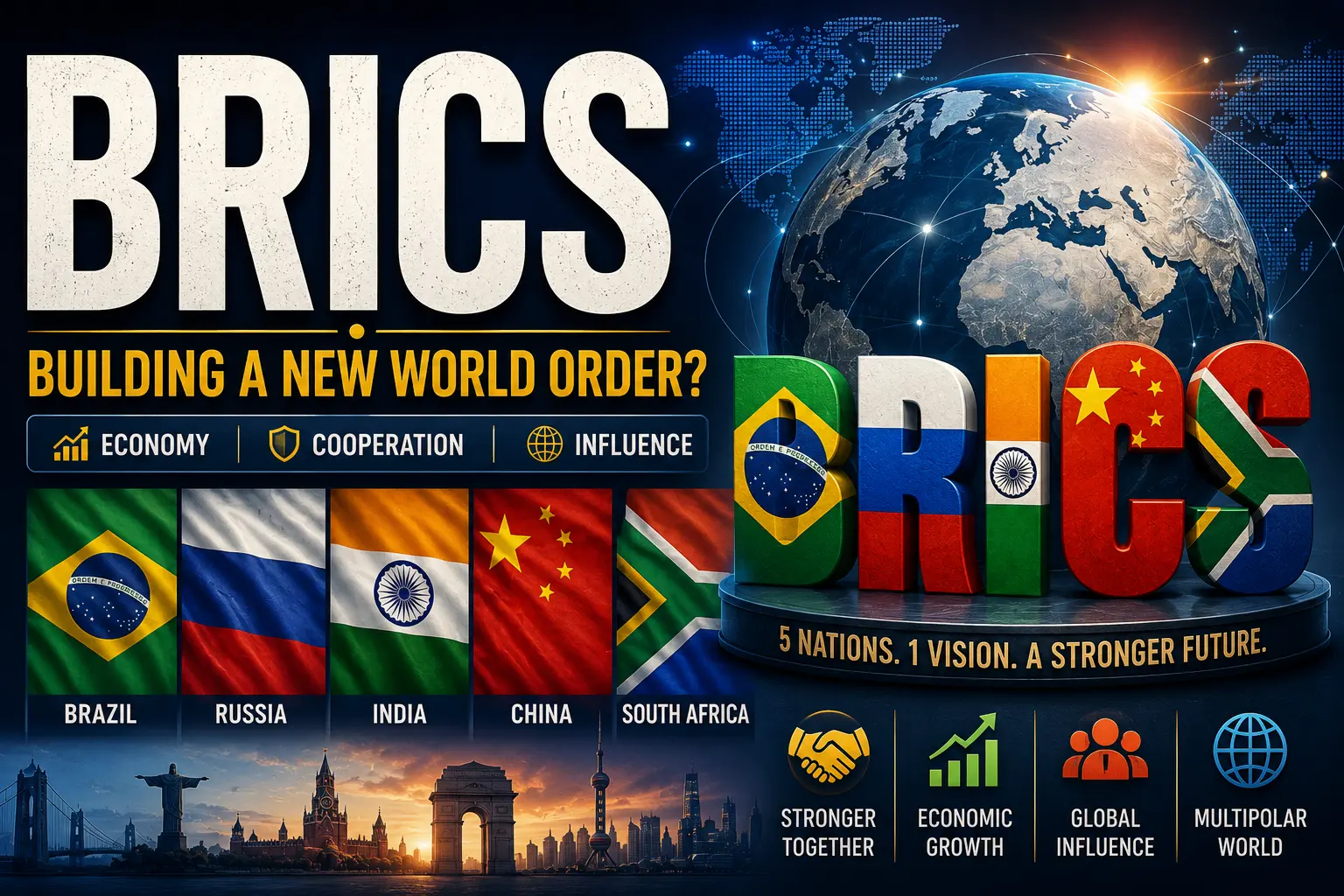
BRICS has grown from a five-country grouping (Brazil, Russia, India, China, South Africa) into a ten-member bloc plus a ten-country "partner" tier, following expansion decisions taken at the 2023 Johannesburg Summit, the 2024 Kazan Summit, and the 2025 Rio de Janeiro Summit. Egypt, Ethiopia, Iran, Saudi Arabia (informally engaged), and the United Arab Emirates joined as full members from January 2024, and Indonesia became the tenth full member in January 2025. Ten more countries — including Belarus, Kazakhstan, Nigeria, Vietnam, Malaysia, Thailand, Cuba, Bolivia, Uganda, and Uzbekistan — hold "BRICS Partner Country" status, a category created at Kazan. Together, the expanded bloc now accounts for roughly half of the world's population and a large and rising share of global GDP, which is why it markets itself as the institutional voice of the Global South and a driver of a more "multipolar" international order.
Why This Topic Matters for UPSC
BRICS expansion sits at the intersection of GS Paper II (International Relations, groupings and agreements involving India) and GS Paper III (economy, international financial institutions). It has appeared in various forms in Prelims (grouping membership, related institutions like the New Development Bank) and Mains (India's role in a multipolar world, reform of global governance, Global South leadership). Because the bloc keeps adding members almost every year, static facts memorised even twelve months ago can go stale — which is exactly why this article separates durable concepts from time-bound data, and gives you verified figures rather than recycled ones.
1. From BRIC to BRICS to BRICS Plus: A Short Timeline
The grouping's evolution is best understood in five stages.
2001 — The idea is born. The acronym "BRIC" was not created by the four countries themselves; it was coined by Goldman Sachs economist Jim O'Neill to describe fast-growing emerging economies that he believed would reshape the global economy over subsequent decades.
2009 — Formal grouping begins. Brazil, Russia, India and China held their first formal summit, converting an investment-bank shorthand into an actual intergovernmental forum focused on economic cooperation and reform of global institutions.
2010 — South Africa joins. South Africa was invited to join the following year, turning BRIC into BRICS and giving the grouping a foothold on the African continent — a detail the bloc later leaned on heavily when it began styling itself as a Global South champion.
2023 — The Johannesburg expansion decision. At the 15th BRICS Summit in Johannesburg, the five leaders agreed to invite Argentina, Egypt, Ethiopia, Iran, Saudi Arabia and the United Arab Emirates to become full members from 1 January 2024. Argentina's incoming government under Javier Milei subsequently declined the invitation, meaning only five of the six actually joined as scheduled, alongside Saudi Arabia's participation remaining informal rather than fully ratified in practice.
2024 — The Kazan Summit and the Partner Country category. Meeting in Kazan, Russia, in October 2024, BRICS leaders formally endorsed a new tier called the "BRICS Partner Country Category." The Kazan Declaration stated that extending BRICS partnership to a wider set of emerging and developing economies would deepen solidarity and genuine international cooperation. Unlike full membership, the declaration did not name the specific invitees in the text itself, but Russian officials subsequently confirmed that thirteen countries had been approached, and nine of them — Belarus, Bolivia, Cuba, Indonesia (at the time still pending full membership), Kazakhstan, Malaysia, Thailand, Uganda and Uzbekistan — confirmed readiness to take up partner status from 1 January 2025.
2025 — Indonesia's full membership and further partner additions. Indonesia, Southeast Asia's largest economy, was admitted as BRICS's tenth full member on 6 January 2025, having originally been approved in principle at Johannesburg but delayed by its own domestic political transition. By the time of the 17th BRICS Summit in Rio de Janeiro in July 2025, the bloc had also welcomed additional partner countries such as Nigeria and Vietnam, bringing the total partner list to around ten nations. At that point, BRICS as a combined structure of full members and partners comprised roughly twenty countries.
What this timeline tells us: expansion did not happen in one dramatic leap. It has occurred in three distinct waves — Johannesburg (2023), Kazan (2024), and Rio (2025) — each adding a different type of member and refining the bloc's internal architecture. For exam purposes, remember the two-tier structure: full members (with voting rights, veto-style consensus power, and a seat in decision-making) and partner countries (invited to summits and ministerial meetings, and permitted to endorse joint declarations, but without full membership privileges).
2. Who Is In BRICS Today?
Full Members (10, as of the 2025 Rio Summit)
| Country | Year Joined |
|---|---|
| Brazil | Founding member (2009) |
| Russia | Founding member (2009) |
| India | Founding member (2009) |
| China | Founding member (2009) |
| South Africa | 2010 |
| Egypt | 2024 |
| Ethiopia | 2024 |
| Iran | 2024 |
| United Arab Emirates | 2024 |
| Indonesia | 2025 |
Note: Saudi Arabia was invited alongside the 2024 cohort and has engaged with BRICS activities, but Riyadh has not issued a definitive public confirmation of full membership, so many trackers still list it as "invited/under consideration" rather than confirmed.
Partner Countries (around 10, as of mid-2025)
This tier includes Belarus, Bolivia, Cuba, Kazakhstan, Malaysia, Nigeria, Thailand, Uganda, Uzbekistan and Vietnam. The exact list has shifted slightly as individual countries formalised their status through 2025, so students should treat this as an evolving list rather than a fixed one for exam purposes — always check the latest official BRICS or Ministry of External Affairs update closer to an exam date.
GEO/AI-search note: If you are asking an AI assistant or search engine "how many countries are in BRICS," the accurate answer as of mid-2026 is ten full members and roughly ten partner countries — not the original five, and not simply "eleven," which was only briefly true in early 2025 before Indonesia's accession and the Rio partner additions.
3. The Economic Weight Behind the Political Claims
Numbers matter here because BRICS's entire pitch — that it deserves a bigger say in global governance — rests on demographic and economic scale. Using verified World Bank and Trading Economics data for the original five members in 2024:
| Country | GDP, current US$ (2024) |
|---|---|
| China | ≈ US$18.27–18.7 trillion |
| India | ≈ US$3.89 trillion |
| Brazil | ≈ US$2.18–2.19 trillion |
| Russia | ≈ US$2.17–2.18 trillion |
| South Africa | ≈ US$400 billion |
Combined, the original five economies alone produced close to US$27 trillion in 2024, with a shared population estimated around 3.2–3.3 billion people. Once the five newer full members and the partner-country tier are added, independent trackers estimate the enlarged BRICS grouping now accounts for roughly 40–44% of global GDP measured in purchasing-power-parity terms, and slightly over half of the world's population — a scale unmatched by any other single grouping, including the G7.
A useful exam-safe distinction: BRICS's dominance is much larger when GDP is measured in purchasing power parity (PPP) terms than in nominal (current US$) terms, because China and India's PPP-adjusted output is proportionally larger than their nominal output. When you see headline claims like "BRICS is bigger than the G7," check whether the comparison uses PPP or nominal figures — this single caveat is a common UPSC-style trap.
4. Institutional Muscle: The New Development Bank
Political rhetoric about the Global South only carries weight if it is backed by functioning institutions. The clearest test case is the New Development Bank (NDB), headquartered in Shanghai and established in 2015 by the original five BRICS countries.
Verified figures from the NDB's own investor disclosures and annual reporting show:
- By the end of 2024, the NDB's active project portfolio stood at 105 projects, with cumulative Board-approved financing since inception running into the tens of billions of dollars — figures in the US$35–40 billion range depending on whether "active portfolio" or "all-time cumulative approvals" is being counted.
- The bank successfully raised US$16.1 billion in international capital markets during 2024 alone, a notable achievement given that it had struggled to access international bond markets for roughly fifteen months earlier in its history.
- NDB membership itself has been expanding independently of BRICS's own membership rules — by mid-2025 it counted eleven member countries, including non-BRICS states such as Bangladesh, Egypt, the United Arab Emirates, Algeria, Colombia and Uzbekistan, showing that the bank is positioning itself as a broader multilateral lender rather than a purely BRICS-exclusive vehicle.
- Lending is concentrated in four priority areas: transport and logistics infrastructure, clean energy and the energy transition, digital infrastructure, and social infrastructure such as water, sanitation and urban development.
For UPSC purposes, the NDB is significant because it is frequently compared with the World Bank and Asian Development Bank as an alternative source of development finance that does not attach the same conditionalities historically associated with Bretton Woods institutions. However, its lending volumes remain a fraction of the World Bank Group's — a useful corrective to any exaggerated claim that the NDB has "replaced" Western-led development finance.
5. The Global South Framing: Substance or Slogan?
BRICS increasingly describes itself using Global South language rather than purely "emerging market" language. The 2024 Kazan Declaration explicitly welcomed the considerable interest shown by Global South countries in the bloc and linked expansion to amplifying developing-country voices within forums like the G20.
It is worth being precise about what "Global South" actually means, since the term is often used loosely in exam answers:
- The Global South is not a formal treaty organisation with a single membership list. It is a political and economic shorthand for developing and middle-income countries — largely, though not exclusively, in Africa, Asia and Latin America — that share an interest in reforming trade rules, climate finance arrangements, and voting power inside institutions like the IMF and World Bank.
- BRICS has effectively positioned itself as a self-appointed convening platform for this loose category, hosting "BRICS Plus" outreach dialogues that invite non-member developing countries to participate in discussions alongside the formal summit.
- The bloc's declarations consistently call for reform of the United Nations Security Council, greater voting-share realignment at the IMF, and changes to World Trade Organization dispute-resolution and negotiation processes to better reflect what they term "emerging markets and developing countries" (EMDCs) — a term BRICS documents use repeatedly instead of "Global South," even though the two overlap heavily in practice.
- The Kazan Declaration also explicitly criticised unilateral coercive economic measures — a diplomatic phrase generally understood to reference Western sanctions regimes — arguing they undermine development, food security, public health and poverty reduction in developing nations.
A balanced reading, useful for a Mains answer, is that BRICS uses Global South language partly out of genuine shared interest in institutional reform, and partly as a strategic branding exercise that helps China and Russia, in particular, present an anti-Western coalition as a broader developing-world movement rather than a great-power rivalry. Both things can be true simultaneously, and a good answer should acknowledge this tension rather than picking one interpretation.
6. Internal Diversity: The Bloc's Biggest Structural Challenge
A recurring UPSC theme is asking candidates to evaluate whether a grouping can translate scale into coherent action. BRICS illustrates this problem well.
- Economic asymmetry. China's GDP alone is larger than the combined GDP of every other full member put together. This creates an inherent risk that BRICS decision-making tilts toward Beijing's preferences, even though the bloc formally operates by consensus.
- Political and security divergence. The expanded membership now includes countries with sharply different foreign-policy alignments — for instance, Iran and the UAE, or India and China, have unresolved bilateral tensions of their own (the India-China border dispute being the most consequential for India's own calculus). Managing consensus among ten full members with genuinely different security postures is structurally harder than it was among the original five.
- No common currency, despite speculation. Contrary to a persistent misconception, BRICS has not created a common currency. The Kazan Declaration endorsed continued work on trade in national currencies and cross-border payment connectivity — including exploratory work on a "BRICS Clear" settlement mechanism intended to reduce dependence on Western-controlled payment messaging systems — but stopped well short of a unified monetary unit, partly due to India's own reluctance and partly because of the group's underlying economic heterogeneity. Any exam answer or general-knowledge claim asserting that "BRICS has launched a common currency" is factually incorrect as of mid-2026 and should be avoided.
- Trade-off between scale and speed. A ten-member bloc with ten more partner countries attending its meetings is, almost by definition, slower at reaching consensus than a five-member bloc was. This is the central strategic tension analysts flag repeatedly: BRICS has gained geographic reach and bargaining weight, but at some cost to internal coherence and decision-making speed.
7. What This Means for India
India occupies a genuinely distinct position within BRICS, and this nuance is worth building into any Mains answer on India's multi-alignment strategy.
- India is simultaneously a founding BRICS member and a member of the Quad (with the US, Japan and Australia) — a grouping widely seen as at least partly a counterweight to China's regional influence. This dual membership is often cited as the clearest illustration of India's "multi-alignment" foreign policy, in which New Delhi avoids exclusive camps and instead participates in multiple, sometimes overlapping, groupings to maximise its own strategic and economic space.
- India has been notably cautious about BRICS initiatives that could be read as explicitly anti-Western or anti-dollar, such as discussions of alternative payment systems, precisely because India continues to value its economic and strategic relationships with the United States and European partners.
- At the same time, India has consistently supported BRICS's institutional-reform agenda — particularly UN Security Council reform (where India seeks permanent membership) and greater IMF/World Bank voting-share realignment for developing economies — because these goals align with India's own long-standing diplomatic objectives, independent of the bloc's Russia-China dynamics.
- The India-China patrolling arrangement along the Line of Actual Control, confirmed on the margins of the 2024 Kazan Summit, is a good illustration of how BRICS summits sometimes double as venues for bilateral diplomacy between member states that have their own separate, tense relationship outside the BRICS framework.
8. Frequently Asked Questions
How many countries are in BRICS as of 2026? BRICS has ten full members — Brazil, Russia, India, China, South Africa, Egypt, Ethiopia, Iran, the United Arab Emirates and Indonesia — plus roughly ten partner countries that participate in summits and ministerial meetings without full voting rights.
Does BRICS have a common currency? No. BRICS has expanded trade settlement in national currencies and discussed a cross-border payment infrastructure, but it has not adopted, and has not committed to adopting, a single common currency.
What is the BRICS Partner Country category? It is a tier created at the 2024 Kazan Summit that allows invited countries to attend BRICS summits and foreign ministers' meetings, join select discussion sessions, and endorse joint declarations — without becoming full members with consensus/veto power over decisions.
What is the New Development Bank and how is it different from the World Bank? The NDB is a multilateral development bank founded by the original five BRICS countries in 2015 to finance infrastructure and sustainable-development projects, primarily in member and partner countries. Unlike the World Bank, its membership and voting structure were designed around the founding BRICS states, though it has since added several non-BRICS shareholder countries.
Is BRICS the same as the Global South? No. The Global South is a broad, informal category covering most developing countries; BRICS is a specific intergovernmental grouping that has positioned itself as a leading voice for Global South interests, but it does not represent or speak for all Global South countries, many of which are not members or partners.
9. Practice Question for Mains
"BRICS expansion reflects an attempt to convert demographic and economic scale into institutional leverage over global governance, but internal diversity limits its coherence." Critically examine this statement with reference to recent developments (2023–2025). (250 words)
Approach hint: Structure your answer around three pillars — (1) evidence of institutional ambition (Partner Country category, NDB lending data, UN/IMF/WTO reform demands), (2) evidence of genuine leverage (population and GDP-PPP share, Global South convening power), and (3) evidence of internal constraints (China's economic dominance, divergent foreign policies among members, no common currency, India's cautious multi-alignment). Conclude with a balanced assessment rather than a one-sided verdict — examiners reward answers that hold both the achievement and the limitation in view simultaneously.
10. Key Takeaways
- BRICS expanded in three distinct phases: Johannesburg (2023 decision, 2024 effective membership), Kazan (2024, Partner Country category), and Rio (2025, Indonesia's full membership and further partner additions).
- The bloc now has ten full members and roughly ten partner countries, together covering around half the world's population and a large share of global GDP in PPP terms.
- The New Development Bank gives BRICS a genuine, if still modest by World Bank standards, institutional financing arm — with 105 active projects and billions in fresh capital-market borrowing as of end-2024.
- "Global South" is a useful political umbrella term, not BRICS's formal membership list; treat claims equating the two with caution.
- No common BRICS currency exists; trade-in-national-currencies and payment-infrastructure work are real but distinct from a monetary union.
- For India, BRICS is one pillar of a broader multi-alignment strategy that coexists with Quad membership and separate bilateral ties with the West — not a substitute for either.