What Citizenship Means — and What is Unique About India's Model
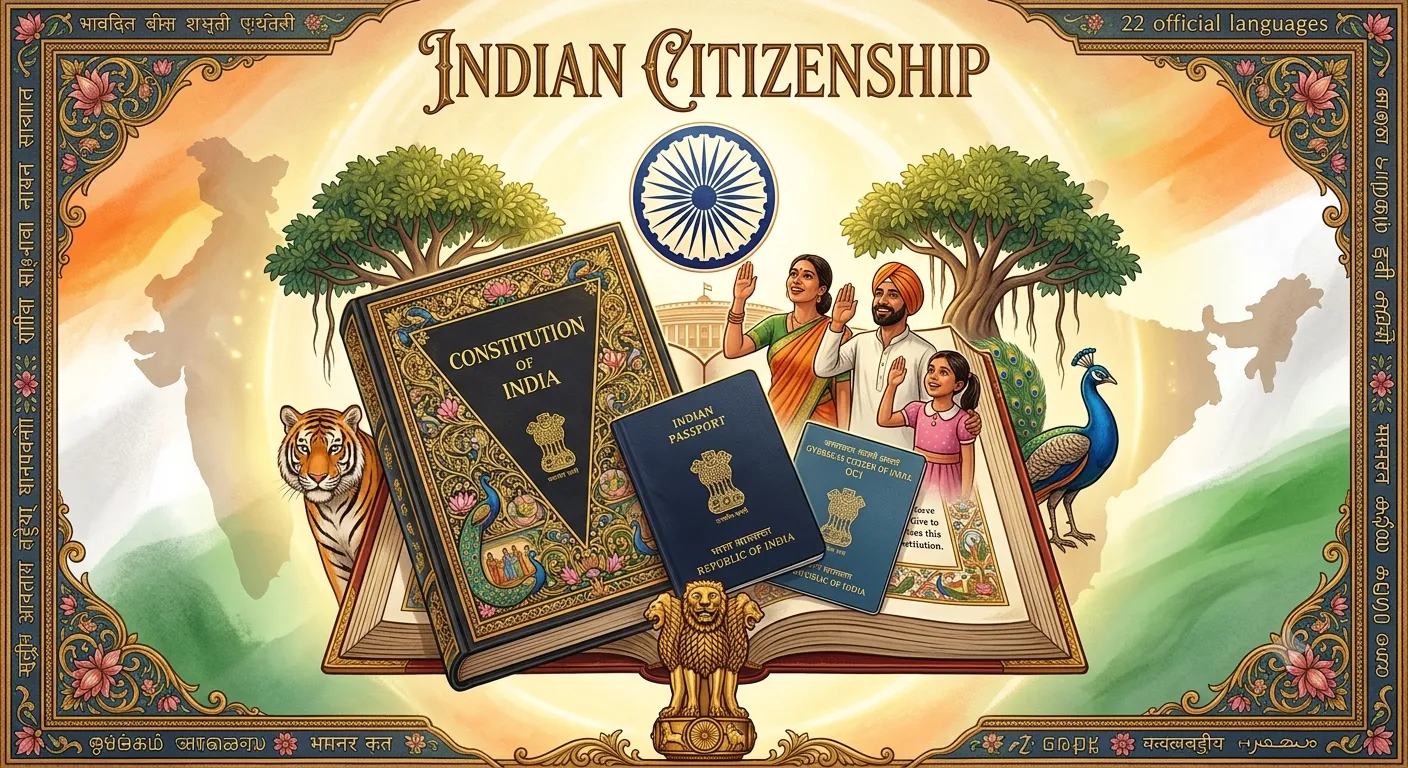
Citizenship is the legal tie between a person and a sovereign state. It is not the same as residence, domicile, or nationality in the loose sense. A citizen owes allegiance to the state. The state, in return, owes that person a defined set of rights and protections.
India has single citizenship. Every Indian is a citizen of the Union — not of any state separately. You cannot be a "citizen of Maharashtra" or "citizen of Kerala" in any legal sense. This is different from the United States, where state citizenship exists alongside federal citizenship, and from some other federations.
The framers of the Constitution made this choice deliberately. A diverse, newly partitioned nation needed one unifying legal identity above regional loyalties.
The Constitution itself does not lay down a permanent code of citizenship law. Part II (Articles 5–11) settled who was a citizen at the time of commencement — January 26, 1950. For everything after, Article 11 hands the power to Parliament. That power was exercised through the Citizenship Act, 1955 — still the primary statute, though amended multiple times since.
Citizenship is the legal tie between a person and a sovereign state. It is not the same as residence, domicile, or nationality in the loose sense. A citizen owes allegiance to the state. The state, in return, owes that person a defined set of rights and protections.
India has single citizenship. Every Indian is a citizen of the Union — not of any state separately. You cannot be a "citizen of Maharashtra" or "citizen of Kerala" in any legal sense. This is different from the United States, where state citizenship exists alongside federal citizenship, and from some other federations.
The framers of the Constitution made this choice deliberately. A diverse, newly partitioned nation needed one unifying legal identity above regional loyalties.
The Constitution itself does not lay down a permanent code of citizenship law. Part II (Articles 5–11) settled who was a citizen at the time of commencement — January 26, 1950. For everything after, Article 11 hands the power to Parliament. That power was exercised through the Citizenship Act, 1955 — still the primary statute, though amended multiple times since.
The Constitutional Settlement: Articles 5–11
The framers faced a specific problem in 1950. Partition had created mass displacement. Millions had moved across borders in both directions. The Constitution had to draw a legal line — who was Indian on day one?
The framers faced a specific problem in 1950. Partition had created mass displacement. Millions had moved across borders in both directions. The Constitution had to draw a legal line — who was Indian on day one?
Articles 5–11 at a Glance
Art. 5 (Citizenship at commencement): A person domiciled in India was a citizen if:
(a) born in India, or
(b) either parent born in India, or
(c) ordinarily resident for 5+ years before Jan 26, 1950.
Art. 6: Migrants from Pakistan before July 19, 1948 — deemed citizens if parent/grandparent born in undivided India. Those arriving after July 19, 1948 needed to register with an officer.
Art. 7: Migrants to Pakistan after March 1, 1947 — NOT automatically citizens, even if born in India. Exception: if they returned on a resettlement or permanent return permit, they could apply.
Art. 8: Indian-origin persons living abroad — eligible to register as citizens if a parent/grandparent was born in undivided India, through the nearest Indian diplomatic mission.
Art. 9: Voluntarily acquiring foreign citizenship terminates Indian citizenship automatically. No dual citizenship — this is a constitutional bar, not just a statutory choice.
Art. 10 (Continuity clause): Every person who is or is deemed to be a citizen under Arts. 5–8 continues as one, subject to any law Parliament makes.
Art. 11: Parliament's plenary power to legislate on citizenship. This is the source authority for the Citizenship Act, 1955 and all its amendments.
Note on Article 7: Article 7 is often underestimated. It shows the Constitution's intent clearly: migration to Pakistan was treated as a legal break from India, not a reversible accident. People who migrated had to actively return and prove their intent to resettle — they did not get automatic citizenship just because they were born on Indian soil.
Art. 5 (Citizenship at commencement): A person domiciled in India was a citizen if:
(a) born in India, or
(b) either parent born in India, or
(c) ordinarily resident for 5+ years before Jan 26, 1950.
Art. 6: Migrants from Pakistan before July 19, 1948 — deemed citizens if parent/grandparent born in undivided India. Those arriving after July 19, 1948 needed to register with an officer.
Art. 7: Migrants to Pakistan after March 1, 1947 — NOT automatically citizens, even if born in India. Exception: if they returned on a resettlement or permanent return permit, they could apply.
Art. 8: Indian-origin persons living abroad — eligible to register as citizens if a parent/grandparent was born in undivided India, through the nearest Indian diplomatic mission.
Art. 9: Voluntarily acquiring foreign citizenship terminates Indian citizenship automatically. No dual citizenship — this is a constitutional bar, not just a statutory choice.
Art. 10 (Continuity clause): Every person who is or is deemed to be a citizen under Arts. 5–8 continues as one, subject to any law Parliament makes.
Art. 11: Parliament's plenary power to legislate on citizenship. This is the source authority for the Citizenship Act, 1955 and all its amendments.
Note on Article 7: Article 7 is often underestimated. It shows the Constitution's intent clearly: migration to Pakistan was treated as a legal break from India, not a reversible accident. People who migrated had to actively return and prove their intent to resettle — they did not get automatic citizenship just because they were born on Indian soil.
Citizenship Act, 1955 — Acquiring Citizenship
The Act gives five methods of acquiring citizenship after commencement. Each has distinct conditions, and they have been tightened considerably over the decades.
The Act gives five methods of acquiring citizenship after commencement. Each has distinct conditions, and they have been tightened considerably over the decades.
Modes of Acquisition
Key Statutory Timelines
11 years: Residence needed for naturalisation (general)
5 years: Residence for CAA-eligible applicants
7 years: Residence for registration (PIO/spouses)
1 year: Window to register foreign-born child at consulate
11 years: Residence needed for naturalisation (general)
5 years: Residence for CAA-eligible applicants
7 years: Residence for registration (PIO/spouses)
1 year: Window to register foreign-born child at consulate
The Jus Soli to Jus Sanguinis Shift (1955–2003)
Jus soli means citizenship by place of birth.
Jus sanguinis means citizenship by blood — i.e., your parents' nationality.
The original 1955 Act followed jus soli: birth in India was, by itself, enough.
The 1986 amendment broke from that. It required at least one parent to be an Indian citizen at the time of birth. The motive was controlling illegal immigration, particularly from Bangladesh in the northeast. But birth was still possible if only one parent qualified.
The 2003 amendment took the final step. If either parent is an "illegal migrant" at the time of the child's birth, the child cannot acquire citizenship by birth — full stop. India now sits firmly in the jus sanguinis camp for birth-based citizenship, placing it alongside countries like Germany (pre-2000) and Japan rather than the US or UK, which still retain strong jus soli.
"India's 2003 amendment placed the entire legal burden of border failure onto the children of undocumented migrants — people who had no say in the circumstances of their birth."
This is a legitimate policy choice, but it has a documented cost: children born in India to undocumented parents are legally stateless from birth. They are not illegal migrants — they were born here. But they carry no citizenship anywhere.
Jus soli means citizenship by place of birth.
Jus sanguinis means citizenship by blood — i.e., your parents' nationality.
The original 1955 Act followed jus soli: birth in India was, by itself, enough.
The 1986 amendment broke from that. It required at least one parent to be an Indian citizen at the time of birth. The motive was controlling illegal immigration, particularly from Bangladesh in the northeast. But birth was still possible if only one parent qualified.
The 2003 amendment took the final step. If either parent is an "illegal migrant" at the time of the child's birth, the child cannot acquire citizenship by birth — full stop. India now sits firmly in the jus sanguinis camp for birth-based citizenship, placing it alongside countries like Germany (pre-2000) and Japan rather than the US or UK, which still retain strong jus soli.
"India's 2003 amendment placed the entire legal burden of border failure onto the children of undocumented migrants — people who had no say in the circumstances of their birth."
This is a legitimate policy choice, but it has a documented cost: children born in India to undocumented parents are legally stateless from birth. They are not illegal migrants — they were born here. But they carry no citizenship anywhere.
Termination, Renunciation, and Deprivation
Citizenship can end in three distinct ways. These are often confused in exam answers.
Renunciation is voluntary. A citizen files a declaration to give up Indian citizenship. If done when India is at war, the government can withhold processing. A critical detail: when a person renounces, their minor children automatically lose citizenship too — though they may reclaim it within one year of turning 18.
Termination is automatic. Under Article 9 and Section 9 of the Act, if an Indian citizen voluntarily acquires the citizenship of a foreign country, Indian citizenship terminates on that date. No formal order is needed — it happens by operation of law.
Deprivation is the state's coercive power to strip citizenship. It applies only to citizens by registration or naturalisation — not to citizens by birth.
Grounds for Deprivation: Citizenship obtained by fraud; disloyalty to the Constitution shown by acts or speech; unlawful trade or communication with an enemy during war; imprisonment for 2+ years within 5 years of naturalisation/registration; or continued residence abroad for 7+ years without intent to return (for registered citizens).
Citizenship can end in three distinct ways. These are often confused in exam answers.
Renunciation is voluntary. A citizen files a declaration to give up Indian citizenship. If done when India is at war, the government can withhold processing. A critical detail: when a person renounces, their minor children automatically lose citizenship too — though they may reclaim it within one year of turning 18.
Termination is automatic. Under Article 9 and Section 9 of the Act, if an Indian citizen voluntarily acquires the citizenship of a foreign country, Indian citizenship terminates on that date. No formal order is needed — it happens by operation of law.
Deprivation is the state's coercive power to strip citizenship. It applies only to citizens by registration or naturalisation — not to citizens by birth.
Grounds for Deprivation: Citizenship obtained by fraud; disloyalty to the Constitution shown by acts or speech; unlawful trade or communication with an enemy during war; imprisonment for 2+ years within 5 years of naturalisation/registration; or continued residence abroad for 7+ years without intent to return (for registered citizens).
Exam Note — Common Confusion
Deprivation under the Citizenship Act cannot strip a citizenship-by-birth citizen. The government can prosecute them, but cannot take away citizenship. This distinction has come up in UPSC Mains GS-II questions on government powers.
Deprivation under the Citizenship Act cannot strip a citizenship-by-birth citizen. The government can prosecute them, but cannot take away citizenship. This distinction has come up in UPSC Mains GS-II questions on government powers.
Overseas Citizenship of India (OCI)
India does not allow dual citizenship. Article 9 makes that a constitutional bar. But in 2005, Parliament introduced the OCI scheme as a practical workaround for the large Indian diaspora.
OCI is a long-term multi-purpose visa, not citizenship.
What an OCI holder can do: Live and work in India indefinitely, open bank accounts, own non-agricultural and non-plantation property, and travel without a separate visa.
What they cannot do: Vote, contest elections, hold constitutional posts, buy agricultural land, or be appointed to the civil services.
The earlier PIO (Person of Indian Origin) card scheme was merged with OCI in 2015 to avoid duplication. Citizens of Pakistan and Bangladesh are explicitly excluded from OCI eligibility.
The 2019 amendment to the Citizenship Act allowed the central government to cancel OCI registration if the holder violates any provision "under the Act or any other law." Critics argue this is too broad — "any other law" could include minor traffic violations. There is currently no independent appellate tribunal; the government's cancellation order is the final word unless challenged in a High Court.
India does not allow dual citizenship. Article 9 makes that a constitutional bar. But in 2005, Parliament introduced the OCI scheme as a practical workaround for the large Indian diaspora.
OCI is a long-term multi-purpose visa, not citizenship.
What an OCI holder can do: Live and work in India indefinitely, open bank accounts, own non-agricultural and non-plantation property, and travel without a separate visa.
What they cannot do: Vote, contest elections, hold constitutional posts, buy agricultural land, or be appointed to the civil services.
The earlier PIO (Person of Indian Origin) card scheme was merged with OCI in 2015 to avoid duplication. Citizens of Pakistan and Bangladesh are explicitly excluded from OCI eligibility.
The 2019 amendment to the Citizenship Act allowed the central government to cancel OCI registration if the holder violates any provision "under the Act or any other law." Critics argue this is too broad — "any other law" could include minor traffic violations. There is currently no independent appellate tribunal; the government's cancellation order is the final word unless challenged in a High Court.
Citizenship Amendment Act, 2019 — Law, Debate, and Current Status
The CAA 2019 amended the Citizenship Act to offer an accelerated path to naturalisation for members of six religious communities — Hindus, Sikhs, Buddhists, Jains, Parsis, and Christians — who entered India from Afghanistan, Bangladesh, or Pakistan on or before December 31, 2014, and who had faced religious persecution there. The residency requirement for them was cut from 11 years to 5 years.
The rules under CAA were notified in March 2024, making the law fully operational. Applications are processed online through a dedicated portal.
The CAA 2019 amended the Citizenship Act to offer an accelerated path to naturalisation for members of six religious communities — Hindus, Sikhs, Buddhists, Jains, Parsis, and Christians — who entered India from Afghanistan, Bangladesh, or Pakistan on or before December 31, 2014, and who had faced religious persecution there. The residency requirement for them was cut from 11 years to 5 years.
The rules under CAA were notified in March 2024, making the law fully operational. Applications are processed online through a dedicated portal.
Arguments in Support
Afghanistan, Bangladesh, and Pakistan are Islamic Republics by constitution. Non-Muslim minorities have documented grounds for state-sanctioned persecution.
The CAA adds to existing citizenship law — it does not remove any existing Muslim citizen's rights.
Reasonable classification under Article 14 is permissible. The test is whether the classification has an intelligible differentia with a rational nexus to the law's objective.
Sri Lanka and Myanmar are not Islamic Republics — their minorities face different forms of civil conflict, not state religion-based persecution.
Afghanistan, Bangladesh, and Pakistan are Islamic Republics by constitution. Non-Muslim minorities have documented grounds for state-sanctioned persecution.
The CAA adds to existing citizenship law — it does not remove any existing Muslim citizen's rights.
Reasonable classification under Article 14 is permissible. The test is whether the classification has an intelligible differentia with a rational nexus to the law's objective.
Sri Lanka and Myanmar are not Islamic Republics — their minorities face different forms of civil conflict, not state religion-based persecution.
Arguments Against
Muslim minorities in the same three countries — Ahmadiyyas in Pakistan, Shia Hazaras in Afghanistan — are persecuted too, and are excluded by the law.
Using religion as the basis for differential naturalisation may violate the secular character of the Constitution, which is part of its basic structure.
Sri Lankan Tamil Hindus and Rohingya Muslims face documented persecution but are entirely outside the law's scope.
Combined with a future NRC, the law could create a differential safety net — non-Muslims who fail NRC have a legal path; Muslims who fail do not.
Muslim minorities in the same three countries — Ahmadiyyas in Pakistan, Shia Hazaras in Afghanistan — are persecuted too, and are excluded by the law.
Using religion as the basis for differential naturalisation may violate the secular character of the Constitution, which is part of its basic structure.
Sri Lankan Tamil Hindus and Rohingya Muslims face documented persecution but are entirely outside the law's scope.
Combined with a future NRC, the law could create a differential safety net — non-Muslims who fail NRC have a legal path; Muslims who fail do not.
Constitutional Status
Over 200 petitions challenging the CAA are pending before the Supreme Court. The constitutional bench of the Supreme Court has scheduled and initiated final hearings on the matter as of mid-2026, dividing the proceedings between pan-India challenges and region-specific petitions from Assam and Tripura.
The court's core question: does using religion as a classification criterion violate Article 14's reasonable classification test, and does it strike at the secular character of the Constitution as a basic structure element?
Over 200 petitions challenging the CAA are pending before the Supreme Court. The constitutional bench of the Supreme Court has scheduled and initiated final hearings on the matter as of mid-2026, dividing the proceedings between pan-India challenges and region-specific petitions from Assam and Tripura.
The court's core question: does using religion as a classification criterion violate Article 14's reasonable classification test, and does it strike at the secular character of the Constitution as a basic structure element?
NRC and NPR — What They Are and What They Are Not
The National Register of Citizens (NRC) is a register that lists verified Indian citizens. It is a creature of the Citizenship Act, 1955 (Section 14A) and the Citizenship Rules, 2003. So far, it has been conducted only in Assam, under direct Supreme Court supervision following the Assam Accord of 1985.
The National Population Register (NPR) is different. It is a register of all usual residents of India — citizens and non-citizens alike. It is updated under the same 2003 Rules. The NPR is considered the first administrative step toward a potential national NRC, because it builds the resident database from which citizenship can later be verified.
The final Assam NRC, published in August 2019, excluded approximately 19 lakh people. Significantly, many of these were Hindu Bengalis and Gorkhas — not the intended targets of the original Assam Accord, which was focused on Bangladeshi Muslim migration. This produced a political paradox: the BJP government, which supported the CAA as protection for Hindu minorities, found that the NRC in Assam had excluded a large number of Hindus.
The planned 2020 NPR update was paused due to COVID-19. As the government prepares for the upcoming structural Census cycle running through 2026–2027, the Ministry of Home Affairs has noted that a formal directive to simultaneously revive and update the NPR database remains pending.
The National Register of Citizens (NRC) is a register that lists verified Indian citizens. It is a creature of the Citizenship Act, 1955 (Section 14A) and the Citizenship Rules, 2003. So far, it has been conducted only in Assam, under direct Supreme Court supervision following the Assam Accord of 1985.
The National Population Register (NPR) is different. It is a register of all usual residents of India — citizens and non-citizens alike. It is updated under the same 2003 Rules. The NPR is considered the first administrative step toward a potential national NRC, because it builds the resident database from which citizenship can later be verified.
The final Assam NRC, published in August 2019, excluded approximately 19 lakh people. Significantly, many of these were Hindu Bengalis and Gorkhas — not the intended targets of the original Assam Accord, which was focused on Bangladeshi Muslim migration. This produced a political paradox: the BJP government, which supported the CAA as protection for Hindu minorities, found that the NRC in Assam had excluded a large number of Hindus.
The planned 2020 NPR update was paused due to COVID-19. As the government prepares for the upcoming structural Census cycle running through 2026–2027, the Ministry of Home Affairs has noted that a formal directive to simultaneously revive and update the NPR database remains pending.
The CAA–NRC Linkage Question
The government has officially denied any formal linkage between the CAA and a future national NRC. Critics argue the combination creates a structural asymmetry: non-Muslims excluded from an NRC can seek naturalisation cover under the CAA; Muslims in the same position have no such statutory fallback. Whether this constitutes discriminatory architecture or merely separate legal instruments is the core political and constitutional debate.
The government has officially denied any formal linkage between the CAA and a future national NRC. Critics argue the combination creates a structural asymmetry: non-Muslims excluded from an NRC can seek naturalisation cover under the CAA; Muslims in the same position have no such statutory fallback. Whether this constitutes discriminatory architecture or merely separate legal instruments is the core political and constitutional debate.
Citizenship and Fundamental Rights — Who Gets What
A common misconception: all fundamental rights apply only to citizens. That is wrong. Several rights under Part III extend to all persons on Indian territory — including foreigners, stateless persons, and undocumented migrants.
Article 21's extension to all persons has major implications for stateless individuals and undocumented migrants. The Supreme Court has held that even an illegal migrant cannot be deported without due process — because the right to life and a fair hearing under Article 21 protects them while they are on Indian soil.
A common misconception: all fundamental rights apply only to citizens. That is wrong. Several rights under Part III extend to all persons on Indian territory — including foreigners, stateless persons, and undocumented migrants.
Article 21's extension to all persons has major implications for stateless individuals and undocumented migrants. The Supreme Court has held that even an illegal migrant cannot be deported without due process — because the right to life and a fair hearing under Article 21 protects them while they are on Indian soil.
Statelessness — The Legal Gap India Has Not Closed
A stateless person is someone no country recognises as a citizen. India is not a signatory to the 1954 UN Convention Relating to the Status of Stateless Persons, or the 1961 Convention on the Reduction of Statelessness. This is a significant gap.
The Assam NRC created a direct risk. If 19 lakh people are excluded and no country accepts them for deportation — Bangladesh has never acknowledged them as its nationals — they become de facto stateless inside India. They cannot be deported. They cannot be naturalised. There is no domestic statute that defines a legal status for them.
The result: detention in Foreigners' Detention Centres for an indefinite period. The Supreme Court, in multiple hearings, has noted that indefinite detention without a prospect of deportation raises Article 21 concerns. Some detainees have spent 5–7 years in these centres — longer than many criminal sentences.
Children born to excluded NRC parents inside India after 2003 face a further problem: they are not citizens by birth (because of the 2003 amendment) and have no home country to return to. This is textbook statelessness, created by domestic law.
A stateless person is someone no country recognises as a citizen. India is not a signatory to the 1954 UN Convention Relating to the Status of Stateless Persons, or the 1961 Convention on the Reduction of Statelessness. This is a significant gap.
The Assam NRC created a direct risk. If 19 lakh people are excluded and no country accepts them for deportation — Bangladesh has never acknowledged them as its nationals — they become de facto stateless inside India. They cannot be deported. They cannot be naturalised. There is no domestic statute that defines a legal status for them.
The result: detention in Foreigners' Detention Centres for an indefinite period. The Supreme Court, in multiple hearings, has noted that indefinite detention without a prospect of deportation raises Article 21 concerns. Some detainees have spent 5–7 years in these centres — longer than many criminal sentences.
Children born to excluded NRC parents inside India after 2003 face a further problem: they are not citizens by birth (because of the 2003 amendment) and have no home country to return to. This is textbook statelessness, created by domestic law.
Key Judicial Pronouncements
Cases Every UPSC Aspirant Must Know
2005 | Sarbananda Sonowal v. Union of India: SC struck down the Illegal Migrants (Determination by Tribunals) Act, 1983 as unconstitutional. The law placed the burden of proof on the state to prove a person was an illegal migrant — the court held this effectively made detection impossible and constituted an "external aggression" on Assam, triggering Article 355. Led directly to the NRC exercise in Assam being placed under court supervision.
2019 | Assam NRC Proceedings: SC monitored the entire NRC exercise through a bench led by the CJI. The court set deadlines, approved the claims process, and reviewed exclusions. The final list published in August 2019 under court oversight — a rare instance of the judiciary directly supervising a citizenship determination exercise.
Pending | CAA Petitions (250+ petitions): Active Hearings (2026) | A dedicated bench directed the segregation of the 200+ tagged petitions into Pan-India and Assam/Tripura cohorts, slating the case for final substantive hearings mid-2026. The core questions:
Does the religious criterion fail Article 14's intelligible differentia test?
Does it violate the secular basic structure?
Does it read with the NRC create a discriminatory architecture?
General | Louis De Raedt v. Union of India (1991): SC held that Article 21 protects foreigners too. Even non-citizens have the right against arbitrary expulsion and are entitled to a hearing before deportation orders are executed. This remains the foundational precedent for rights of undocumented persons in India.
2005 | Sarbananda Sonowal v. Union of India: SC struck down the Illegal Migrants (Determination by Tribunals) Act, 1983 as unconstitutional. The law placed the burden of proof on the state to prove a person was an illegal migrant — the court held this effectively made detection impossible and constituted an "external aggression" on Assam, triggering Article 355. Led directly to the NRC exercise in Assam being placed under court supervision.
2019 | Assam NRC Proceedings: SC monitored the entire NRC exercise through a bench led by the CJI. The court set deadlines, approved the claims process, and reviewed exclusions. The final list published in August 2019 under court oversight — a rare instance of the judiciary directly supervising a citizenship determination exercise.
Pending | CAA Petitions (250+ petitions): Active Hearings (2026) | A dedicated bench directed the segregation of the 200+ tagged petitions into Pan-India and Assam/Tripura cohorts, slating the case for final substantive hearings mid-2026. The core questions:
Does the religious criterion fail Article 14's intelligible differentia test?
Does it violate the secular basic structure?
Does it read with the NRC create a discriminatory architecture?
General | Louis De Raedt v. Union of India (1991): SC held that Article 21 protects foreigners too. Even non-citizens have the right against arbitrary expulsion and are entitled to a hearing before deportation orders are executed. This remains the foundational precedent for rights of undocumented persons in India.
Way Forward — Specific Administrative and Legislative Gaps
India's citizenship framework has three structural problems that can be addressed through policy, without waiting for constitutional amendments.
Documentation burden in marginalised areas. The Assam NRC showed that poor rural residents, tribal communities, and women with name changes at marriage cannot reliably produce the documentary chain that citizenship verification demands. Any future national NRC must pre-build a district-level grievance mechanism with free legal aid, before the verification exercise begins — not after exclusions are published.
OCI cancellation review. The current power to cancel OCI registration rests entirely with the executive, with no independent appellate body. A statutory review tribunal — insulated from the ministry that issues the cancellation order — would bring the scheme in line with natural justice. The Foreigners Tribunals model, though flawed in Assam, shows that a quasi-judicial structure is feasible.
Statelessness — the missing domestic law. India needs a Stateless Persons (Status) Act or equivalent provision in the Citizenship Act that defines a temporary protected status for persons found to be stateless — giving them work rights, access to education, and a pathway out of detention while their status is being resolved. Continuing to detain people indefinitely because no country will take them is both a legal and administrative failure.
The CAA's constitutional fate rests with the Supreme Court. That outcome cannot be pre-empted. But the administrative machinery — NPR data accuracy, Foreigners Tribunals quality, district-level documentation standards — can be strengthened independently, and should be, before any nationwide exercise is attempted.
India's citizenship framework has three structural problems that can be addressed through policy, without waiting for constitutional amendments.
Documentation burden in marginalised areas. The Assam NRC showed that poor rural residents, tribal communities, and women with name changes at marriage cannot reliably produce the documentary chain that citizenship verification demands. Any future national NRC must pre-build a district-level grievance mechanism with free legal aid, before the verification exercise begins — not after exclusions are published.
OCI cancellation review. The current power to cancel OCI registration rests entirely with the executive, with no independent appellate body. A statutory review tribunal — insulated from the ministry that issues the cancellation order — would bring the scheme in line with natural justice. The Foreigners Tribunals model, though flawed in Assam, shows that a quasi-judicial structure is feasible.
Statelessness — the missing domestic law. India needs a Stateless Persons (Status) Act or equivalent provision in the Citizenship Act that defines a temporary protected status for persons found to be stateless — giving them work rights, access to education, and a pathway out of detention while their status is being resolved. Continuing to detain people indefinitely because no country will take them is both a legal and administrative failure.
The CAA's constitutional fate rests with the Supreme Court. That outcome cannot be pre-empted. But the administrative machinery — NPR data accuracy, Foreigners Tribunals quality, district-level documentation standards — can be strengthened independently, and should be, before any nationwide exercise is attempted.
UPSC Prelims Previous Year Questions (PYQs) on Citizenship
Try to answer yourself
1. UPSC Prelims 2021
Q. With reference to India, consider the following statements:
There is only one citizenship and one domicile.
A citizen by birth only can become the Head of State.
A foreigner once granted citizenship cannot be deprived of it under any circumstance
Which of the statements given above is/are correct?
(a) 1 only
(b) 2 only
(c) 1 and 3
(d) 2 and 3
Answer: (a) 1 only
Q. With reference to India, consider the following statements:
There is only one citizenship and one domicile.
A citizen by birth only can become the Head of State.
A foreigner once granted citizenship cannot be deprived of it under any circumstance
s.
Which of the statements given above is/are correct?
(a) 1 only
(b) 2 only
(c) 1 and 3
(d) 2 and 3
Answer: (a) 1 only
2. UPSC Prelims 2018
Q. Consider the following statements:
Aadhaar card can be used as proof of citizenship or domicile.
Once issued, Aadhaar number cannot be deactivated or omitted by the issuing authority.
Which of the statements given above is/are correct?
(a) 1 only
(b) 2 only
(c) Both 1 and 2
(d) Neither 1 nor 2
Answer: (d) Neither 1 nor 2
Q. Consider the following statements:
Aadhaar card can be used as proof of citizenship or domicile.
Once issued, Aadhaar number cannot be deactivated or omitted by the issuing authority.
Which of the statements given above is/are correct?
(a) 1 only
(b) 2 only
(c) Both 1 and 2
(d) Neither 1 nor 2
Answer: (d) Neither 1 nor 2
3. UPSC Prelims 2005
Q. Consider the following statements:
Articles 371A to 371I were inserted to meet regional demands of Nagaland, Assam, Manipur, Andhra Pradesh, Sikkim, Mizoram, Arunachal Pradesh and Goa.
The Constitutions of India and the USA envisage dual polity but single citizenship.
A naturalized citizen of India can never be deprived of citizenship.
Which of the statements given above is/are correct?
(a) 1, 2 and 3
(b) 1 and 3
(c) 3 only
(d) 1 only
Answer: (d) 1 only
Q. Consider the following statements:
Articles 371A to 371I were inserted to meet regional demands of Nagaland, Assam, Manipur, Andhra Pradesh, Sikkim, Mizoram, Arunachal Pradesh and Goa.
The Constitutions of India and the USA envisage dual polity but single citizenship.
A naturalized citizen of India can never be deprived of citizenship.
Which of the statements given above is/are correct?
(a) 1, 2 and 3
(b) 1 and 3
(c) 3 only
(d) 1 only
Answer: (d) 1 only
4. UPSC Prelims 2019
Q. Which of the following is NOT a method of acquiring Indian citizenship?
(a) By Birth
(b) By Descent
(c) By Registration
(d) By Marriage
Answer: (d) By Marriage
Q. Which of the following is NOT a method of acquiring Indian citizenship?
(a) By Birth
(b) By Descent
(c) By Registration
(d) By Marriage
Answer: (d) By Marriage
5. Citizenship by Descent (Asked in UPSC-based MCQ collections)
Q. Which of the following conditions is required for a person born outside India after 3 December 2004 to acquire citizenship by descent?
(a) Registration of birth at Indian Consulate within 6 months
(b) Birth must occur in a Commonwealth country
(c) Either parent must be a citizen of India
(d) Registration at Indian Consulate within one year or with Central Government permission
Answer: (d)
Sources:
Constitution of India (Part II, Part III); Citizenship Act, 1955 (as
amended 2019); Citizenship Rules, 2003; Sarbananda Sonowal v. Union
of India (2005) 5 SCC 492; Louis De Raedt v. Union of India (1991) 3
SCC 554; Ministry of Home Affairs gazette notifications on CAA Rules
(March 2024); Supreme Court proceedings in CAA petitions (ongoing as
of mid-2025).
Q. Which of the following conditions is required for a person born outside India after 3 December 2004 to acquire citizenship by descent?
(a) Registration of birth at Indian Consulate within 6 months
(b) Birth must occur in a Commonwealth country
(c) Either parent must be a citizen of India
(d) Registration at Indian Consulate within one year or with Central Government permission
Answer: (d)
Sources: Constitution of India (Part II, Part III); Citizenship Act, 1955 (as amended 2019); Citizenship Rules, 2003; Sarbananda Sonowal v. Union of India (2005) 5 SCC 492; Louis De Raedt v. Union of India (1991) 3 SCC 554; Ministry of Home Affairs gazette notifications on CAA Rules (March 2024); Supreme Court proceedings in CAA petitions (ongoing as of mid-2025).