Learn GDP, GNP, and National Income in simple UPSC-friendly language with definitions, …
9
Min Read
1
Sections
Free
Access
Advertisement
Understanding GDP, GNP, and National Income is one of the most important parts of macroeconomics. These three terms are used to measure the size, production, and income of an economy. For UPSC, Kerala PSC, SSC, and other competitive exams, this topic is highly important because questions often test the difference between domestic and national income, gross and net concepts, and market price and factor cost.
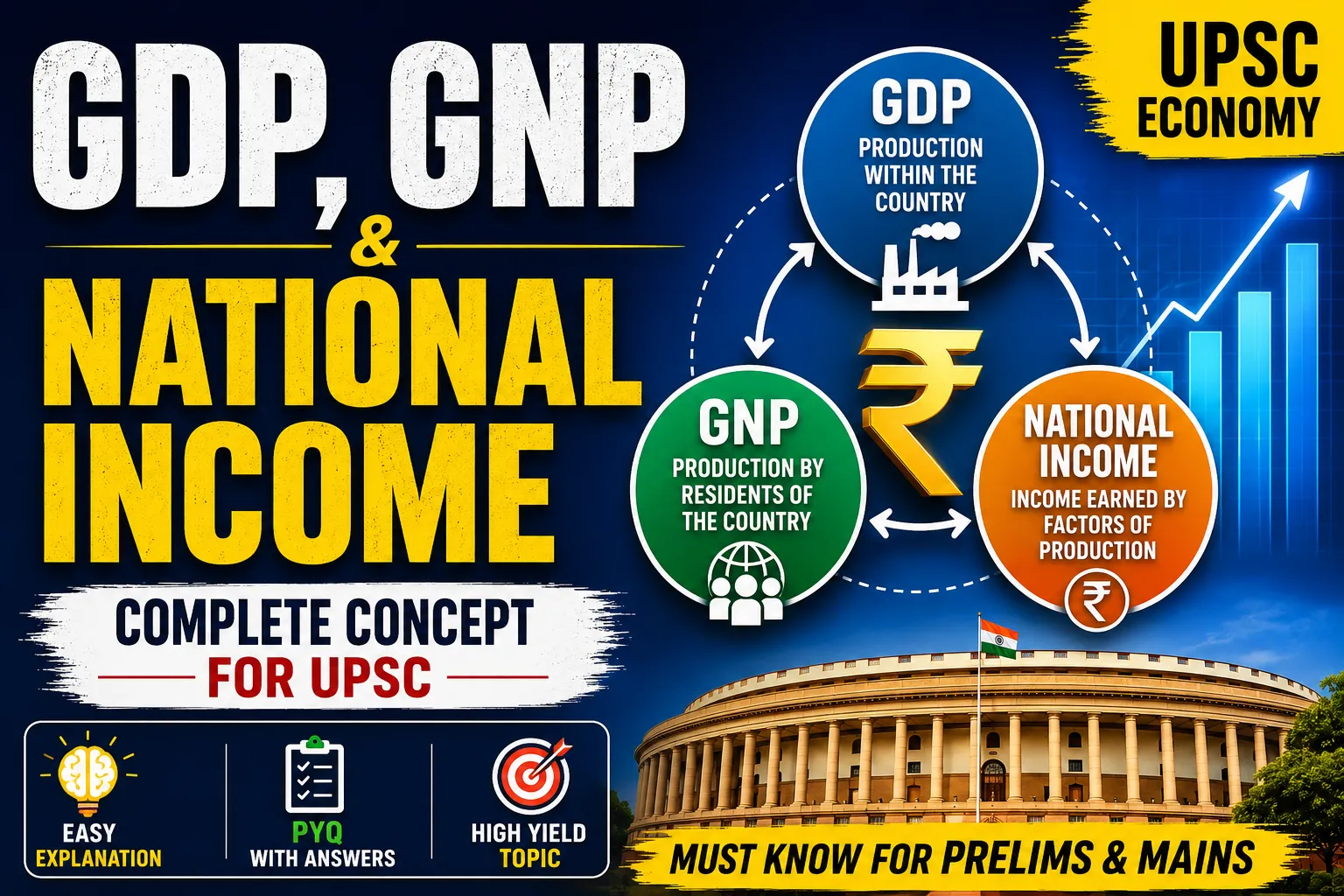
The good news is that this topic becomes very easy once you understand the basic logic. GDP tells us what is produced inside a country, GNP tells us what is produced by the country’s residents, and National Income tells us how much income the factors of production actually earn.
Why this topic matters
Every economy wants to know how much it is producing and how that production turns into income. That is why national income accounting is so important. It helps governments, economists, and students understand growth, performance, and welfare.
This topic also appears in current affairs and state-level exam questions because it connects with development, employment, taxation, remittances, and economic growth. For aspirants, it is not enough to memorize definitions. You must understand the logic behind them.
What is GDP?
GDP stands for Gross Domestic Product. It is the total value of all final goods and services produced within the domestic territory of a country during a particular period, usually one year.
The main idea here is location. If production happens inside the country, it is counted in GDP, no matter who owns the business or who receives the income.
For example:
If an Indian company produces goods in India, that is part of India’s GDP.
If a foreign company produces goods in India, that is also part of India’s GDP.
If an Indian company produces goods in another country, that output is not part of India’s GDP.
Why only final goods are counted
GDP includes only final goods and services. It does not count every raw material separately. This is done to avoid double counting.
For example, wheat, flour, and bread are all connected in production. But only the final bread sold to the consumer is counted fully in GDP. If wheat and flour were counted again and again, the total value would be repeated.
GDP formula
A common formula for GDP is:
GDP = C + I + G + (X - M)
Where:
C = Consumption
I = Investment
G = Government spending
X = Exports
M = Imports
This formula is useful because it shows how total spending in the economy adds up to total production.
What is GNP?
GNP stands for Gross National Product. It measures the total value of final goods and services produced by the residents of a country, whether they are working inside the country or abroad.
The main idea here is people, not place.
So:
Income earned by Indian residents in India is counted.
Income earned by Indian residents abroad is also counted.
Income earned by foreigners inside India is not counted in India’s GNP.
Simple meaning of GNP
GNP tells us how much the nation’s people produce, wherever they may be in the world. It is a broader idea than GDP because it includes income from abroad.
Relationship between GDP and GNP
GNP is calculated by adding Net Factor Income from Abroad to GDP.
GNP = GDP + NFIA
NFIA means:
income earned by residents from abroad
minus
income earned by foreigners from within the country
If residents earn more from abroad than foreigners earn inside the country, NFIA is positive. If the reverse happens, NFIA becomes negative.
What is National Income?
National Income is the total income earned by the factors of production of a country during a year. These factors are:
land
labour
capital
entrepreneurship
In simple words, National Income tells us how much income actually reaches the owners of the productive factors.
In exam terms, National Income is usually taken as:
National Income = Net National Product at Factor Cost
That means we first remove depreciation to get a net measure, and then we adjust for taxes and subsidies to arrive at factor cost.
Why this matters
GDP focuses on output. National Income focuses on income. These are related, but not identical. A country may produce a large amount of goods and services, but the actual income earned by the productive factors may be lower after adjustments.
The exam trap: Market Price vs Factor Cost
This is a very important concept for UPSC and state PSC exams. The price we see in the market is not always the same as the actual income earned by producers.
Market price includes indirect taxes and excludes subsidies. Factor cost, on the other hand, shows the real cost of production or the income earned by the factors of production.
This formula is very important because National Income is measured at factor cost, not at market price.
Simple explanation
If the government adds indirect taxes, the market price becomes higher. If the government gives subsidies, the effective burden becomes lower. To know the actual income earned by land, labour, capital, and entrepreneurship, we remove the tax effect and add subsidies back.
Gross and Net concepts
The words gross and net are easy to confuse, but the difference is simple.
Gross means before subtracting depreciation.
Net means after subtracting depreciation.
What is depreciation?
Depreciation is the reduction in the value of machines, buildings, and other fixed capital due to wear and tear, use, or age.
For example, a machine in a factory loses value every year. That loss is depreciation. Since capital goods wear out over time, economists subtract depreciation to get a more realistic picture.
This shows how the full chain works in a simple and practical way.
Why GDP alone is not enough
GDP is a very useful measure, but it does not tell the full story of development. A country can have high GDP and still face serious problems such as:
unemployment
poverty
inequality
inflation
environmental damage
So GDP shows output, but not necessarily welfare. A rise in GDP does not automatically mean that people’s lives are improving.
For example, if industries grow but pollution also rises sharply, GDP may increase while quality of life does not improve equally. That is why economists study GDP along with other indicators like per capita income, employment, poverty, inflation, and human development.
Current context for 2026
In 2026, India continues to be seen as one of the faster-growing major economies, but policymakers are closely watching whether growth is creating enough jobs and income opportunities. In Kerala, state-level economics remains especially important because service-sector strength and remittance-linked income patterns make GSDP and income flow analysis highly relevant for exam preparation.
Common confusion points
Many students mix up these terms. Here are the most common mistakes:
GDP is not the same as GNP.
Domestic and national are different.
Gross and net are different.
National Income is not just another word for GDP.
Foreign income matters for GNP, not GDP.
Depreciation must be removed to get net figures.
If you keep these differences clear, this topic becomes much easier.
Easy memory trick
Use this simple memory rule:
GDP = place
GNP = people
National Income = actual earnings
Or ask these three questions:
What was produced inside the country?
What did the country’s residents produce?
What income did the productive factors actually earn?
This method is very useful during revision.
Conclusion
GDP, GNP, and National Income are related, but they are not the same. GDP measures production inside the country, GNP measures production by the country’s residents, and National Income measures the income earned by the factors of production. Once you understand the difference between domestic and national, gross and net, and market price and factor cost, this topic becomes much easier.
UPSC Civil Services Prelims Questions
1. Increase in absolute and per capita real GNP do not connote a higher level of economic development, if: (UPSC Prelims 2013)
A) Industrial output fails to keep pace with agricultural output.
B) Agricultural output fails to keep pace with industrial output.
C) Poverty and unemployment increase.
D) Imports grow faster than exports.
Answer: CExplanation: As discussed in the article, GDP and GNP are measures of economic size and output, not necessarily human welfare. If poverty and unemployment are rising, economic development is not reaching the masses, regardless of how high the GNP number goes.
2. The National Income of a country for a given period is equal to the: (UPSC Prelims 2013)
A) Total value of goods and services produced by the nationals.
B) Sum of total consumption and investment expenditure.
C) Sum of personal income of all individuals.
D) Money value of final goods and services produced.
Answer: AExplanation: National Income focuses on the income earned by the nationals (residents) of a country, which aligns with the Net National Product (NNP) concept.
3. National Income in India is officially equivalent to: (UPSC Prelims 1997)
A) Net National Product at Market Price
B) Net National Product at Factor Cost
C) Net Domestic Product at Market Price
D) Gross National Product at Factor Cost
Answer: BExplanation: National income calculates the actual earnings of the factors of production (land, labour, capital, entrepreneurship), which means it must account for depreciation (Net) and remove the effect of indirect taxes and subsidies (Factor Cost).
Kerala PSC & State Exams Questions
4. Which of the following is deducted from GNP to arrive at NNP? (Kerala PSC / SSC CGL)
A) Subsidies
B) Indirect Taxes
C) Depreciation
D) Interest
Answer: CExplanation: The transition from any "Gross" value to a "Net" value is always achieved by subtracting the depreciation (wear and tear of capital).
5. Which agency is responsible for calculating the National Income of India? (Kerala PSC)
A) Reserve Bank of India (RBI)
B) Ministry of Finance
C) National Statistical Office (NSO)
D) NITI Aayog
Answer: CExplanation: While not a formula, this is a highly repeated factual question. The National Statistical Office (NSO)—formerly the Central Statistics Office (CSO)—under the Ministry of Statistics and Programme Implementation is responsible for computing India's GDP and National Income.
Frequently Asked Questions
Practice Makes Perfect
Check out our Mock Tests
Apply what you've learned. Try our extensive collection of UPSC Mock Tests and Previous Year Questions.
We use Functional cookies (required), and optional Analytics and Advertising cookies. Advertising cookies power the free ads that keep this platform free. Privacy Policy
Functional (Required)Login, session security — always active
AnalyticsGoogle Analytics — understand site usage
AdvertisingGoogle AdSense — personalised ads that keep this platform free
Welcome back.
Continue your UPSC, NCERT and CBSE preparation from where you left off.
Sign In
No account?
Join the league.
Free UPSC notes, NCERT summaries, virtual labs and mock tests. Zero cost, forever.
Create Free Account
Already have an account?
Reset access.
We'll help you get back into your account securely.