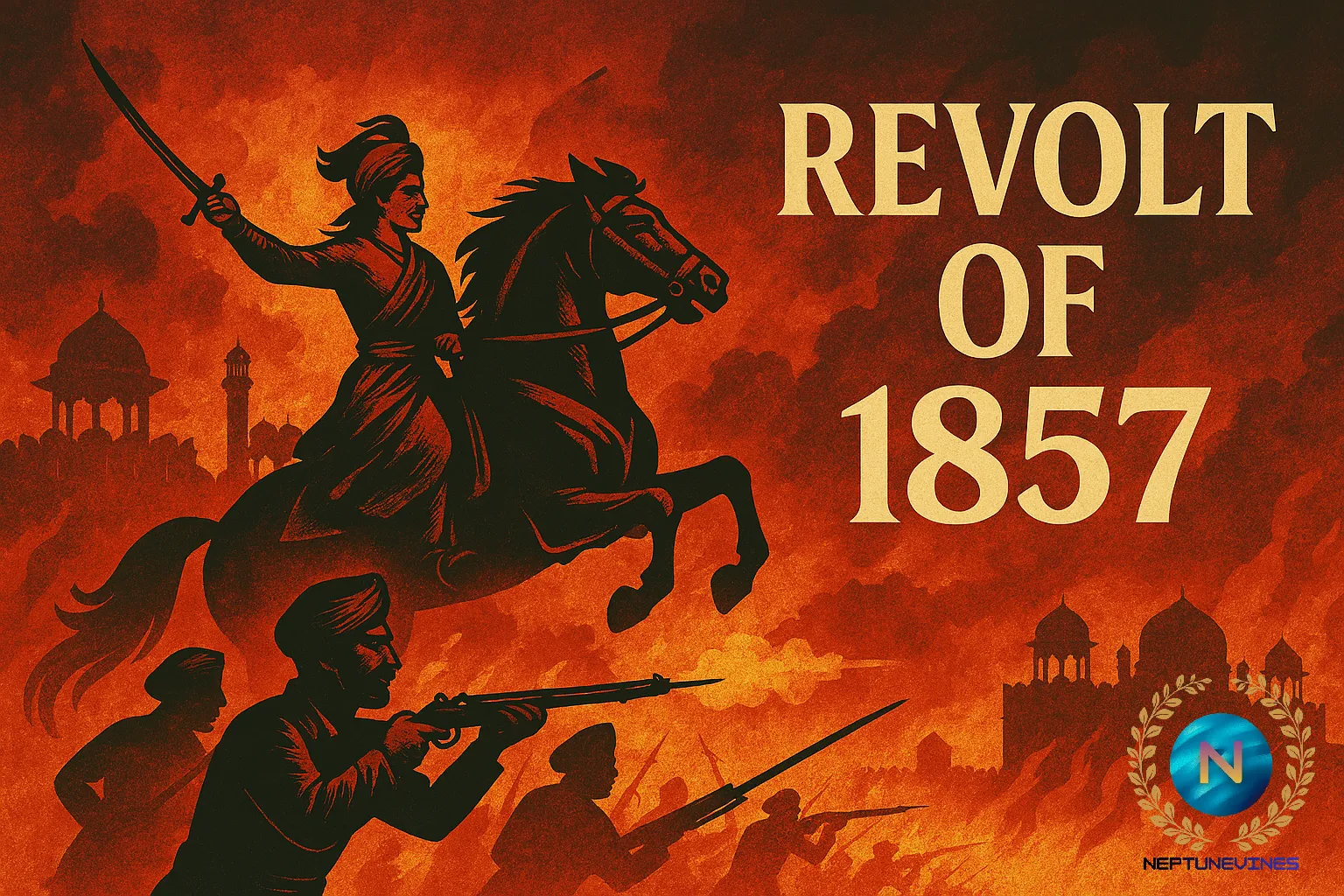
It is often called the Indian Sepoy Mutiny. The British preferred that label for good reason — "mutiny" frames the entire episode as a disciplinary breakdown within an army, not a popular uprising against colonial rule. Indian nationalists later called it the First War of Independence. Neither name is entirely accurate, and that tension tells you something important about how complicated 1857 really was.
The immediate trigger is well known. In early 1857, the East India Company introduced a new rifle — the Pattern 1853 Enfield — that required soldiers to bite off the ends of greased cartridges before loading. Rumor spread, rapidly and with remarkable precision, that the grease was made from a mixture of pig and cow fat. For Muslim and Hindu sepoys alike, this was not a minor grievance. It was a direct assault on religious identity. The Company's reassurances were clumsy and too late. On March 29, 1857, a sepoy named Mangal Pandey attacked British officers at the Barrackpore garrison near Calcutta. He was arrested, tried, and hanged on April 8. That execution did not suppress the anger — it concentrated it.
The real explosion came on May 10 at Meerut, when sepoys of the 3rd Bengal Light Cavalry broke open the jail, freed imprisoned comrades, killed several British officers and their families, and marched through the night to Delhi. Their arrival the next morning changed everything. Delhi was not just a city; it was the seat of Bahadur Shah Zafar, the aged Mughal emperor who had been reduced to a pensioner under Company rule. The sepoys proclaimed him the leader of their revolt. Zafar was in his eighties, had no army of his own, and was deeply ambivalent about the role thrust upon him. He accepted it anyway, and for several months Delhi became the symbolic heart of the uprising.
What followed was neither uniform nor coordinated. That's crucial to understand. The revolt spread across a wide swath of northern and central India — Awadh, Rohilkhand, Bundelkhand, parts of Bihar — but it did not spread everywhere. The Punjab, recently annexed and patrolled by a different composition of troops, remained under British control and actually supplied soldiers used to recapture Delhi. Madras and Bombay presidencies stayed largely quiet. The uprising was most intense precisely in the regions where British expansion had been most disruptive — where landlords had lost revenue rights, where princes had been deposed under the Doctrine of Lapse, where artisans had been undercut by cheap imported goods from Britain.
Awadh is the clearest example of this. The kingdom had been annexed in 1856, just one year before the revolt, on the flimsiest pretext of misgovernance. Its talukdars — the landed aristocracy — had their estates seized almost overnight. When the uprising came to Lucknow, the Awadh capital, it had mass support in a way that went well beyond military grievance. The Begum of Awadh, Hazrat Mahal, emerged as a leader after the British Resident was besieged in the Residency compound. The siege lasted from June 1857 to November 1857, a fact that loomed large in British accounts of the rebellion and contributed to the ferocity of British reprisals.
The British response was, by any measure, savage. After retaking Delhi in September 1857 following weeks of brutal fighting, British officers executed sepoys by tying them to the mouths of cannons and firing. Entire villages suspected of supporting rebels were burned. Bahadur Shah Zafar was captured, tried summarily, and exiled to Rangoon, where he died in 1862. His sons were shot without trial by William Hodson, an act Hodson described with a certain casual satisfaction in his letters home. Reprisals were conducted with what many British officers openly called exemplary terror — the deliberate use of spectacular violence to reassert authority.
One reason the uprising failed, beyond the uneven geography of British control and the lack of coordinated military strategy, was the absence of a unified leadership with a clear political vision. Zafar was a symbol, not a commander. Nana Sahib, who led the uprising at Kanpur and became notorious in Britain for the massacre of British civilians there, was operating largely independently. Rani Lakshmibai of Jhansi — perhaps the most celebrated figure of 1857 — was fighting primarily to recover her own kingdom, which had been annexed under the Doctrine of Lapse after her adopted son was denied succession rights. These were genuine grievances, fiercely defended, but they did not add up to a coordinated nationalist program.
That point has generated real historiographical debate. Early nationalist historians, most notably Vinayak Damodar Savarkar in his 1909 book The Indian War of Independence, argued that 1857 was a planned, unified national revolt. Most contemporary historians are skeptical. The caste and community divisions among the sepoys themselves, the regional patchwork of support and opposition, and the reliance on restoration of older elites — Mughal, Maratha, Awadhi — rather than any new political idea all suggest the limits of calling it a nationalist uprising in the modern sense. It was, more accurately, a massive popular resistance to colonial rule that drew on a range of local, religious, dynastic, and economic grievances simultaneously.
That doesn't diminish it. If anything, it makes 1857 more interesting as history. The uprising forced the British Crown to dissolve the East India Company and assume direct rule over India in 1858, producing the formal structure of the British Raj. It reshaped how the British administered India — more cautious about rapid social reform, more attentive to religious sensitivities, more reliant on the "loyal" communities and princes who had not rebelled. And it left a deep imprint on Indian political memory, one that later nationalist figures like Bal Gangadhar Tilak would actively cultivate as they built the case for independence.
1857 is not a clean story with a clean lesson. It was messy, regionally fragmented, internally divided, and ultimately suppressed with considerable violence. But it remains one of the largest armed resistances to colonial rule in the nineteenth century, and understanding why it happened — and why it failed — tells you an enormous amount about how British power in India actually worked.
1857 Revolt — UPSC Reference Table
Key Causes
| Category | Specific Cause | UPSC Relevance |
|---|---|---|
| Military | Greased cartridges (Enfield rifle) — pig & cow fat rumor | Direct trigger; often asked as a short note |
| Political | Doctrine of Lapse (Dalhousie) — Jhansi, Satara, Nagpur, Jaitpur annexed | Policy cause; linked to Rani Lakshmibai |
| Economic | Drain of wealth; destruction of Indian handicrafts; heavy land revenue | Economic nationalism angle |
| Social/Religious | Widow Remarriage Act (1856), missionary activity, fear of forced conversion | Social reform as provocation |
| Administrative | Annexation of Awadh (1856) on misgovernance grounds | Most cited political cause |
Key Centres of Revolt & Leaders
| Centre | Leader(s) | Outcome |
|---|---|---|
| Meerut | Sepoys of 3rd Bengal Light Cavalry | Spark point — May 10, 1857 |
| Delhi | Bahadur Shah Zafar II | Recaptured by British — September 1857; Zafar exiled to Rangoon |
| Lucknow (Awadh) | Begum Hazrat Mahal | Siege of Residency; revolt had mass civilian support |
| Kanpur | Nana Sahib, Tantia Tope | Massacre of British civilians; brutal British reprisal |
| Jhansi | Rani Lakshmibai | Died in battle at Gwalior — June 1858 |
| Bareilly | Khan Bahadur Khan | Declared governor of Rohilkhand under Zafar |
| Arrah (Bihar) | Kunwar Singh | 80-year-old zamindar; effective guerrilla commander |
| Gwalior | Tantia Tope (after Kanpur) | Escaped, captured, and executed in 1859 |
Areas That Did NOT Revolt — and Why
| Region | Reason for Loyalty / Calm |
|---|---|
| Punjab | Recently annexed; Sikhs still resentful of Mughal/Maratha power; British used Sikh troops against rebels |
| Madras & Bombay Presidencies | Different regimental composition; less disruption from Doctrine of Lapse |
| Hyderabad | Nizam remained loyal; Berar already ceded but no armed resistance |
| Rajputana | Princes largely loyal; British policy of non-annexation kept them cooperative |
| Bengal (proper) | Educated middle class (bhadralok) largely supported British; reform movements had different agenda |
Consequences & Aftermath
| Consequence | Details | UPSC Angle |
|---|---|---|
| End of East India Company | Government of India Act, 1858 | Crown takes direct control |
| Secretary of State for India | New Cabinet post in London; replaced Board of Control | Constitutional change |
| Viceroy replaces Governor-General | Lord Canning became first Viceroy | Nomenclature change + symbolic shift |
| Queen's Proclamation (Nov 1, 1858) | Promised no further annexations, respect for Indian religions, equal law | Often quoted in exams; basis of future imperial "contract" |
| Army Reorganization | Ratio of British to Indian troops increased; artillery kept exclusively with British | Direct military lesson drawn from revolt |
| Policy of "Divide and Rule" | More deliberate use of caste, community, and religious identities in recruitment | Long-term political consequence |
| Princely States Policy | Princes who stayed loyal were rewarded; annexation policy abandoned | Explains why 565 princely states survived to 1947 |
Historiographical Interpretations
| Historian / School | Interpretation | Key Work / Quote |
|---|---|---|
| British (contemporary) | "Sepoy Mutiny" — military indiscipline, not political revolt | John Lawrence, John Kaye |
| V.D. Savarkar (1909) | First planned War of Indian Independence | The Indian War of Independence |
| R.C. Majumdar | Neither a national war nor a first — called it a "spontaneous" revolt with limited scope | The Sepoy Mutiny and the Revolt of 1857 |
| S.N. Sen (official govt. view) | A genuine revolt but not fully national in character | Eighteen Fifty-Seven (commissioned by Govt. of India) |
| Marxist historians | Feudal reaction to colonial capitalism; not a bourgeois nationalist movement | Eric Stokes, Irfan Habib |
| Subaltern Studies | Focus on peasant and subaltern participation beyond elite leaders | Ranajit Guha's framework applied |
Related Acts & Policies (Pre and Post 1857)
| Act / Policy | Year | Relevance to 1857 |
|---|---|---|
| Doctrine of Lapse | 1848 (Dalhousie) | Major political cause of revolt |
| Wood's Despatch | 1854 | Education policy — anglicization fears |
| Awadh Annexation | 1856 | Single biggest political trigger |
| Government of India Act | 1858 | Direct constitutional consequence |
| Indian Councils Act | 1861 | First step toward legislative inclusion of Indians post-revolt |
| Queen's Proclamation | 1858 | Policy reset — promises and limits of British rule stated formally |
One-Liner UPSC Facts
- The revolt began on May 10, 1857 at Meerut.
- Mangal Pandey was executed on April 8, 1857 at Barrackpore.
- Bahadur Shah Zafar was tried under Section 14 of the Bengal State Prisoners Regulation.
- Delhi was recaptured by British forces on September 20, 1857.
- The revolt is officially called "The Revolt of 1857" in NCERT; not "mutiny" or "war of independence."
- The Doctrine of Lapse was quietly abandoned after 1858 — never formally repealed but never applied again.
- Rani Lakshmibai died on June 18, 1858, fighting near Gwalior; she was 29 years old.
- Kunwar Singh of Arrah, Bihar, was around 80 years old during the revolt — the oldest commander.
- Lord Canning's moderate reprisal policy earned him the nickname "Clemency Canning" from hawkish British opinion.
- The Queen's Proclamation of 1858 is sometimes called India's "Magna Carta" of imperial rule — though that label is debated.
UPSC Prelims PYQs with Explanations
Q1. Which one of the following places did not rise in revolt during 1857?
(a) Lucknow
(b) Kanpur
(c) Jhansi
(d) Madras
Answer: (d) Madras
Explanation: The revolt was concentrated in North and Central India (Delhi, Kanpur, Lucknow, Jhansi, Bihar). The southern regions like Madras and Bombay remained largely unaffected due to stronger British control and lack of local grievances.
Q2. Who among the following was the British Commissioner of Chotanagpur during the 1857 Uprising who fled Ranchi for Hazaribagh?
(a) Dalton
(b) Hume
(c) Cleveland
(d) Wilcox
Answer: (a) Dalton
Explanation: Commissioner Dalton abandoned Ranchi during the uprising. This highlights how even administrative officers fled in panic when rebellion spread in tribal and rural areas.
Q3. Which of the following was not a cause of the Revolt of 1857?
(a) Doctrine of Lapse
(b) Annexation of Awadh
(c) Introduction of railways
(d) Greased cartridges
Answer: (c) Introduction of railways
Explanation: While railways symbolized modernization, they were not a direct cause of revolt. The main causes were political annexations (Doctrine of Lapse, Awadh), economic exploitation, and military grievances (greased cartridges).
Q4. Who among the following was not associated with the Revolt of 1857?
(a) Nana Saheb
(b) Kunwar Singh
(c) Khan Abdul Ghaffar Khan
(d) Rani Lakshmibai
Answer: (c) Khan Abdul Ghaffar Khan
Explanation: He was a 20th-century freedom fighter (Frontier Gandhi), active in the 1930s–40s. The others were prominent leaders of 1857.
Q5. The Revolt of 1857 was described as the “First War of Independence” by:
(a) R.C. Majumdar
(b) V.D. Savarkar
(c) S.N. Sen
(d) Jawaharlal Nehru
Answer: (b) V.D. Savarkar
Explanation: Savarkar’s book “The Indian War of Independence, 1857” popularized the nationalist interpretation. British historians called it a “sepoy mutiny,” while nationalist historians elevated it as the first war of independence.
Common UPSC Mistakes on the Revolt of 1857
1. Calling it a “Pan-India” revolt
Nope. It wasn’t.
Many aspirants write that the revolt was nationwide. But it was mostly limited to North and Central India — Delhi, Kanpur, Lucknow, Jhansi, and Bihar. South India and most of the East stayed quiet. UPSC loves to trap you here.
2. Ignoring the role of peasants and tribal groups
It wasn’t just sepoys.
People often focus only on the army. But local zamindars, peasants, and tribal leaders like Birsa Munda (though later) had their own resistance. Kunwar Singh in Bihar was a zamindar, not a sepoy.
3. Confusing leaders and their regions
UPSC loves this mix-up.
- Rani Lakshmibai → Jhansi
- Nana Saheb → Kanpur
- Bahadur Shah Zafar → Delhi
- Kunwar Singh → Bihar
Get one wrong, and boom — negative marking.
4. Skipping causes and consequences
Don’t just memorize the revolt — understand why it happened and what changed.
- Causes: Doctrine of Lapse, greased cartridges, annexation of Awadh, economic exploitation
- Consequences: End of East India Company, Queen’s Proclamation, start of direct Crown rule
5. Forgetting historiography
UPSC loves historian debates.
- R.C. Majumdar: It wasn’t a war of independence
- V.D. Savarkar: It was
Mentioning these views in Mains gives you brownie points.
6. Not linking it to later movements
It’s not isolated.
The revolt set the tone for future resistance. Even though it failed, it inspired later freedom fighters. Mention this in Mains to show continuity.
Exam Trick
• UPSC often tests factual recall (leaders, places, causes).
• They also test historiographical interpretations (mutiny vs. war of independence).
• Linking leaders with their regions (e.g., Rani Lakshmibai – Jhansi, Kunwar Singh – Bihar, Nana Saheb – Kanpur) is a common trap area.