Syllabus Tag: GS Paper 1: Indian National Movement — Intellectual and Social Foundations.
The foundation of the INC was not just about fighting the British; it was about creating "India" as a political entity.
Indian National Congress
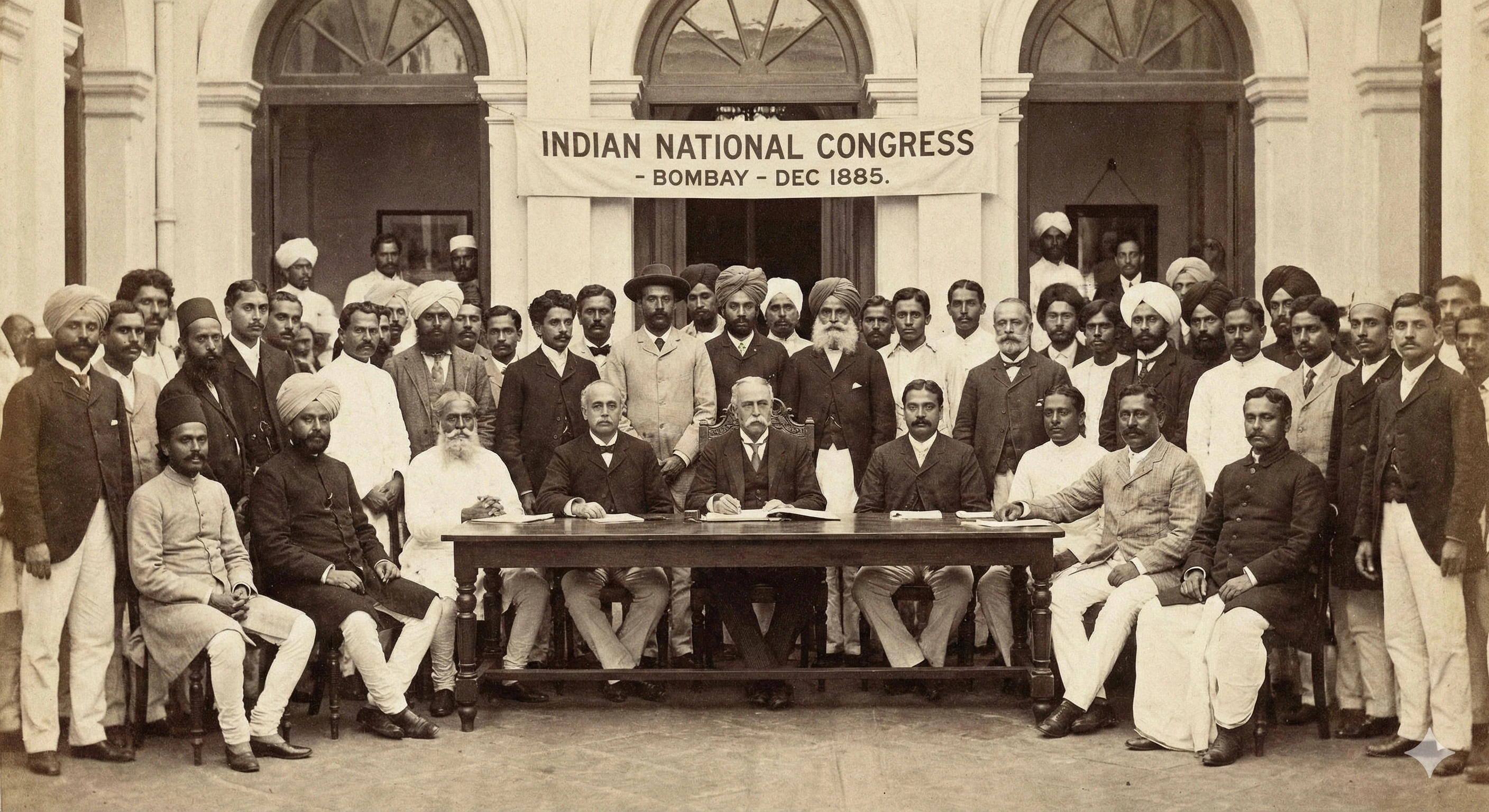
The Indian National Congress (INC), founded in 1885, is one of the oldest political parties. Initially formed as a platform for moderate political reforms and Indian representation under colonial rule.
The INC didn't appear out of thin air; it was preceded by regional organizations like the Indian Association of Calcutta (1876), led by Surendranath Banerjee and Ananda Mohan Bose. They had already organized the "All-India National Conference" in 1883.
Cause and effects: The British refused to lower the age limit for the Civil Service, and the racial hostility during the Ilbert Bill controversy acted as the final "push" factor. This made the leaders think that the regional organizations are too weak to resist a colonial power.
Foundation of the Indian National Congress
- Many Indians were planning to establish an All-India Organisation of a political nature for workers and activists.
- It was A.O Hume, a retired English civil servant, who mobilised the intellectuals and founded the Indian National Congress in 1885.
- With the support of the intellectuals of that time, the first session ofthe Indian National Congress (INC) was held at Bombay in December 1885 at Gokuldas Tejpal Sanskrit College.
- The first session of INC was attended by 72 delegates and presided over by Womesh Chandra Bonnerjee (W C Bonnerjee).
- From here, each Congress session was held every year in December in different parts of the country.
Objectives of INC
- During the first session of the Indian National Congress, W C Bonnerjee declared the following as the objectives of the INC.
- Training and Organisation of public opinion in the country.
- Promotion of friendly relations between nationalist political workers from different parts of the country.
- Formulation of popular demands.
Safety Valve Theory
- According to this theory, the Inc was established as a safety wall to protect the British Empire from the growing discontent among Indians.
- AO hume convinced Lord Dufferin not to obstruct the formation of the Congress
- WC Bonnerjee stated the idea of INC was first suggested to hume By Governor General Lord Dufferin.
- The historian Bipan Chandra says that if you want to use the con as a safety, the early Congress hoped him as a lightning Conductor.
Indian National Congress and its aims
- Found a democratic nationalist movement.
- politicize and politically educate people.
- Establish the headquarters for a movement.
- Promote friendly relations among nationalist political workers from different parts of the country.
- formulate and present popular demands before the government with a view to unifying the people over A common economic and political programme.
- Develop and consolidate a feeling of national unity among people irrespective of religion, caste, or province.
- carefully promote and nurture Indian nationhood.
The second session of the International Congress [the Calcutta session]
- In 1886, the Indian National Congress Delegates met at Calcutta.
- From 72 delegates in Bombay, the Congress swelled to 434 delegates in the Calcutta session.
- The main objective of the international congress was the inclusion of people in it. The composition of Congress was all India in character, with Delegates belonging to different races, castes, professions, trades, and provinces.
- There were a handful of women delegates as well. In 1890, Kadambini Ganguly, the first woman graduate of Bethune College, Calcutta University, addressed the Congress session.
- Dada bhai Navroji was the president at that time.
Table of INC Presidents, sessions, and outcomes
| Year and Place | President | Important outcomes |
| 1885 | W C Bonnerjee |
|
| 1886- Calcutta session | dadabhai Naoroji |
|
| 1887- Madras | Syed Badruddin Tyabji |
|
| 1888- Allahabad | George Yule |
|
| 1889- Bombay | Sir William Wudderburn | |
| 1890- Calcutta | ferocious Mehta | |
| 1891- Nagpur | P Ananda Charlu | |
| 1892 - Allahabad | WC Bonerjee | |
| 1893- Lahore | Dadabhai Navroji | |
| 1894 Madras | Alfred Webb | |
| 1895 - Pune | Surendranath Banerjee |
|
| 1896- Calcutta | Rahimatullah M Sayani |
|
| 1897 Amravati | C Shankaran Nair | |
| 1898- Madras | Ananda Mohan Bose | |
| 1899- Lucknow | Romesh Chandar Dutt | |
| 1900- Lahore | N G Chandavarkar | |
| 1901- Calcutta | D E Wacha | |
| 1902- Ahmedabad | Surendranath Banerjee | |
| 1903- Madras | Lal Mohan Ghosh | |
| 1904- Bombay | Henry Cotton | |
| 1905 - Banaras | Gopal Krishna Gokhale | |
| 1906- Calcutta | Dadaabai Navroji | |
| 1907- Surat | Rash Behari Ghosh | |
| 1908- Madras | Rash Behari Ghosh | |
| 1909- Lahore | Madan Mohan Malaviya |
|
| 1910- Allahabad | William Vedder Burn | |
| 19 1 1 Calcutta | Bishan Narayan Dar |
|
| 1912- Bankipore | Raghunath Narasimha Mudholkar | |
| 1913- Karachi | Nawab Saeed Mohammed Bahadur | |
| 1914 - Madras | Bhupendranath Bose | |
| 1915 - Bombay | Satyendra Prasanna Sinha | |
| 1916- Lucknow | Ambica Charan Mazumdar |
|
| 1917 - Calcutta | Annie Besant |
|
| 1918 - Delhi | Madan Mohan Malaviya | |
| 1918 - Bombay (special session) | Saeed Hassan Imam | |
| 1919- Amritsar | Motilal Nehru |
|
| 1920- Nagpur | Vijayaraghavachariar |
|
| 1921- Ahmedabad | Hakim Ajmal Khan |
|
| 1922 - Gaya | Desh Bandhu Chittaranjan das |
|
| 1923- Delhi | Maulana Abdul Kalam Azad |
|
| 1924 - Belgaum | MK Gandhi |
|
| 1925 Kanpur | Sarojini Naidu |
|
| 1926 - Gawahati | S Srinivasa Ayyangar | |
| 1927 - Madras | MA ansari |
|
| 1928 - Calcutta | Motilal Nehru |
|
| 1931 Karachi | Sardar Vallabhbhai Patel | |
| 1933 - Calcutta | Nellie Sengupta | |
| 1934 - Bombay | Dr Rajendra Prasad |
|
| 1936 - Lucknow | Jawaharlal Nehru | |
| 1937 - Faizpur | Jawaharlal Nehru |
|
| 1938 - Haripura | Subhash Chandra Bose |
|
| 1939 - Tripura | Subhash Chandra Bose | |
| 1940 Ramgarh | Maulana Abdul Kalam Azad |
|
| 1946- Meerut | JB Kripalani |
|
Significance for UPSC
- Evolution: The Indian National Congress has transformed into a moderate mass movement under leaders like Gandhi.
- UPSC relevance: Costumes are often asked about the theories, like the safety valve, the Founders, and early sessions. Always try to link to broader teams like nationalism, colonial policies, and the role of British liberals.
Previous Year Questions (PYQs) of the UPSC Civil Services Examination serve as a vital resource, offering insights into exam trends, recurring themes, and the depth of analysis expected.
UPSC Prelims PYQ Related to INC Formation
1990s & Older (Direct Factual Questions)
Q. Who was the first President of the Indian National Congress?
Answer: W.C. Bonnerjee (1885, Bombay Session).
Q. Who founded the Indian National Congress?
Answer: A.O. Hume (Allan Octavian Hume).
Q. How many delegates attended the first session of the INC?
Answer: 72 delegates.
Q. Where was the first session held?
- Gokul das tejpal sanskrit college.
2003
Q. Who among the following was NOT present at the founding session of the Indian National Congress? (a) Dadabhai Naoroji
(b) G. Subramaniya Aiyar
(c) Justice Ranade
(d) Surendranath Banerjee
Answer: (d)
Explanation: Surendranath Banerjee was absent because he was conducting the second session of his own organization, the Indian National Association, in Calcutta at the same time. His organization merged with the INC in 1886.
2008
Q. Who among the following rejected the title of Knighthood and refused to accept a position in the Council of the Secretary of State for India?
(a) Motilal Nehru
(b) M.G. Ranade
(c) G.K. Gokhale
(d) B.G. Tilak
Answer: (c)
Relevance: G.K. Gokhale was a key figure in the early phase of the INC and a proponent of the "Lightning Conductor" theory regarding its formation.
2013
Q. The Ilbert Bill controversy was related to the: (a) Imposition of certain restrictions to carry arms by the Indians, (b) Imposition of restrictions on newspapers and magazines published in Indian languages, (c) Removal of disqualifications imposed on the Indian magistrates about the trial of the Europeans, (d) Removal of a duty on imported cotton cloth
Answer: (c)
Relevance: The Ilbert Bill controversy (1883) is considered the immediate political precursor that united Indians and necessitated the formation of an all-India organization like the INC.
2015
Q. Consider the following statements:
The first woman President of the Indian National Congress was Sarojini Naidu.
The first Muslim President of the Indian National Congress was Badruddin Tyabji.
Which of the statements given above is/are correct?
(a) 1 only
(b) 2 only
(c) Both 1 and 2
(d) Neither 1 nor 2
Answer: (b)
Explanation: The first woman President was Annie Besant (1917). Sarojini Naidu was the first Indian woman President (1925). Badruddin Tyabji was indeed the first Muslim President (1887, Madras Session).
UPSC Mains PYQ Related to INC Formation
In Mains, questions on the formation of the INC focus on the intent behind its creation (Safety Valve Theory) and its early nature (Elitist vs. National).
2016: "Was the Indian National Congress a 'Safety Valve' or a 'Lightning Conductor'? Analyze the circumstances leading to its formation."
2008: "Trace the origin of the Indian National Congress. How far was it the result of the political awakening of the 19th century?"
1997: "Discuss the extent to which the Indian National Congress was a 'Safety Valve' for the British Raj."
1991: "Discuss the 'Safety Valve' theory. Does it satisfactorily explain the foundation of the Indian National Congress?"