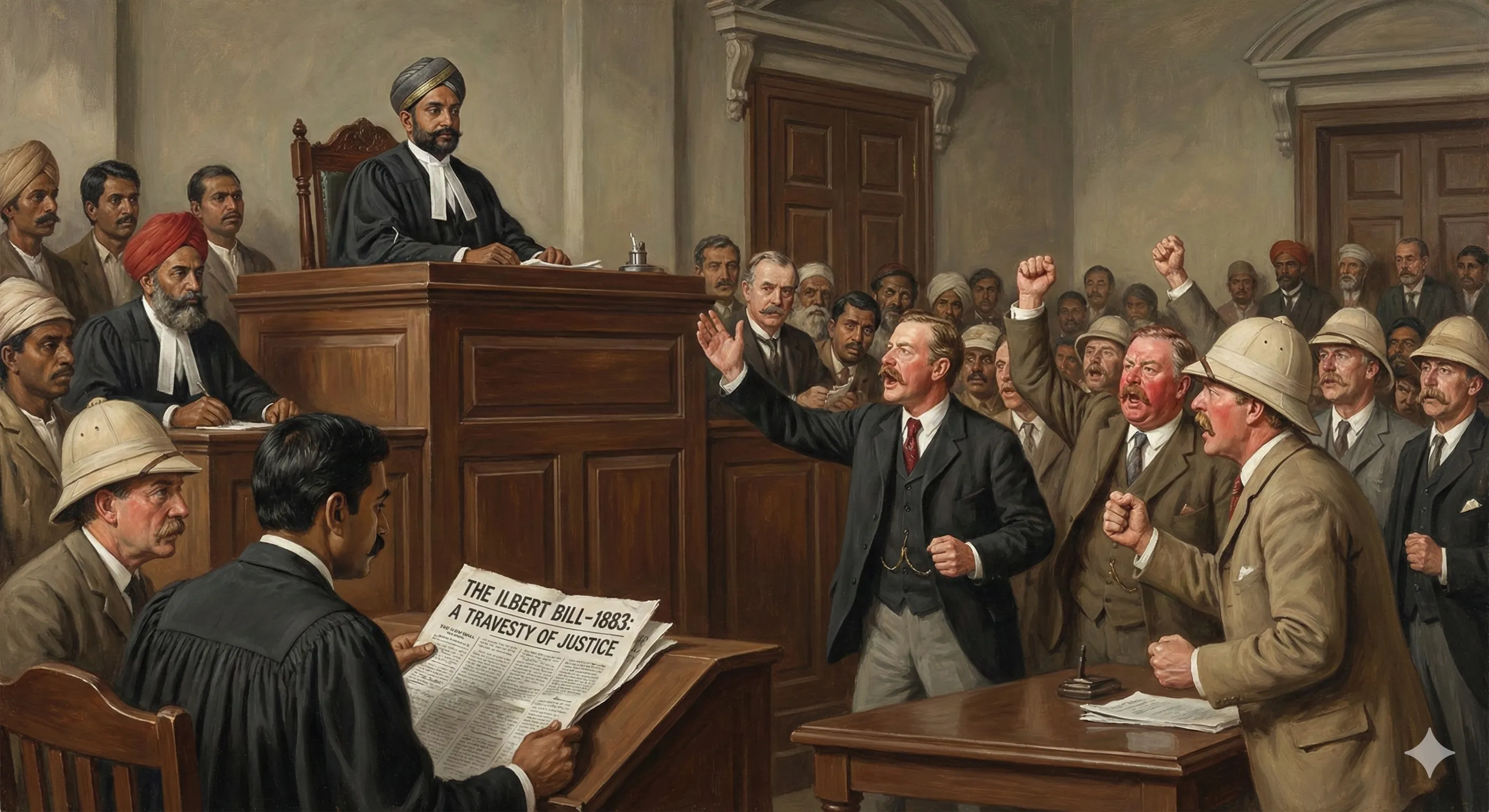
The Ilbert Bill was proposed in 1883 by Sir Courtney Ilbert, who was a member of the viceroy's council under Lord Rippon's Administration. The Bill is intended to remove judicial disqualification based on race.
Ilbert Bill Controversy Background
Before the enactment of the Ilbert Bill, the judicial system of British India was running in favor of Europeans. Indian magistrates were not allowed to try a European.
- Ilbert Bill was introduced in 1883 to remove this imbalance in the judicial system during the reign of Lord Ripon.
- Lord Ripon had a larger reform idea to increase equality within the colonial administration.
- But the Bill made an agitation among the Europeans, because they considered the Indians as inferior to them.
Why Europeans opposed the Ilbert Bill
- Racial Superiority: The reaction of Europeans in India against the Ilbert Bill was terrible. They argued that the Bill is unacceptable for Europeans, who they considered superior to be tried by Indian judges. They said Indian judges are unfit to try Europeans.
- The tea and indigo planters of Bengal were also against the Ilbert Bill; they thought Indian judges would be biased against them.
- Some people spread the idea that European women are not safe under Indian judges.
Critical Analysis
- Racial superiority and Lord Ripon's intent: The viceroy Lord Ripon aimed to establish the administration aligned to queens' proclamation in 1858 which promised equal treatment regardless of race.
- White Mutiny: The Introduction of Ilbert Bill triggered the European community in India including the tea and indigo planters of Calcutta and the civil servants. Regarding the anger they formed European Defense Association, and raised big funds then started propaganda against Lord Ripon.
- The compromise of the Ilbert Bill (1884): Faced with threats of violence and a near-revolt by the white officers. The enacted Bill was a skeleton of its former self. While allowing Indian district judges to preside over cases involving Europeans, it added a Provision that the European offenders could demand a jury trial where at least 50% of the members were European. This effectively nullified the possibility of an Indian judge convicting a European against the community's will.
Ilbert Bill: Original Intent vs. Final Compromise
| Feature | The Original Proposal (1883) | The Final Compromise Act (1884) |
| Objective | Racial equality in judicial administration in district areas. | Appeasing European sentiment while saving face for the Viceroy. |
| Indian Judges' Power | Senior Indian Covenanted Civilians (District Magistrates/Sessions Judges) could try European British subjects without a jury requirement. | Indian Judges could preside, BUT the European accused gained the right to demand a special jury. |
| Jury Composition | No specific racial requirement set for these trials. | Mandatory that at least 50% of the jury members must be Europeans or Americans. |
| Net Result | Genuine judicial equality in theory. | Equality in form, European dominance in practice. |
Common Student Mistakes
Believing the Bill was completely withdrawn.: A common misconception among aspirants is that the Ilbert Bill was completely withdrawn entirely due to opposition. In reality, the Bill was passed into law, but only after being severely compromised to maintain European privilege. It is crucial that your answers reflect this nuance rather than simply stating it failed
Below are questions that have appeared in previous UPSC examinations concerning the Ilbert Bill controversy. They test your understanding of its core objective and the reasons behind its contentious outcome.
1. UPSC Civil Services Preliminary Exam (2013)
Q. The Ilbert Bill controversy was related to the:
(a) imposition of certain restrictions on the Indian press by the British.
(b) withdrawal of financial autonomy granted to the provinces.
(c) removal of disqualifications imposed on the Indian magistrates with regard to the trial of the Europeans.
(d) grant of constitutional autonomy to the provinces.
Correct Answer: (c)
Explanation: The primary objective of the Ilbert Bill, introduced during Lord Ripon’s viceroyalty, was to remove a judicial anomaly based on race.
It sought to allow senior Indian magistrates in district courts (mofussil) to try criminal cases involving European British subjects—a power they previously lacked, despite holding equal rank to their British counterparts.