Ancient Indian History
Time Line
| Period | Date Range |
|---|---|
| Lower Palaeolithic | 2 million BP – 80,000 BP |
| Middle Palaeolithic | 80,000 BP – 35,000 BP |
| Upper Palaeolithic | 35,000 BP – 12,000 BP |
| Mesolithic | 12,000 BP – 10,000 BP |
| Neolithic | 10,000 BP – 6,000 BP |
| Chalcolithic | 6,000 BP – 2,600 BCE |
| Harappan Civilisation | 2,600 BCE – 1,000 BCE |
| Use of Iron | 1,000 BCE – 600 BCE |
| Early Historic | 600 BCE – 400 CE |
The study of ancient Indian history is important as it tells us how, when and where people developed the earliest cultures in our country.
The Sources of Ancient Indian History
The sources of ancient Indian history are broadly classified as archaeological and historical sources.
Archaeological Sources
These sources include:
- Material remains
- Pottery
- Inscriptions
- Coins
The one who studied archaeological sources is known as an archaeologist.
Material Remains
The archaeological excavations show the layout of how the settlements were in that time and how people lived, the type of pottery they used, the form of houses in which they dwelled, the kind of cereals they used as food, and the type of tools and implements they handled.
The buildings made of stone and brick tell us about the great building activities in the past.
Dating in Archaeology
The dating of ancient materials is done through radio carbon method, carbon-potting dating. The history of climate and vegetation is known through an examination of plant residue and especially through pollen analysis.
Pottery
Another material remaining that we got from the ancient sites are potteries.
Various kinds of pottery have been discovered through excavations. Red and black pottery was used by the people of the Indus Valley Civilization while the Painted Grey Ware (PGW) pottery was in use during the Vedic Age.
Coins
Coins are one of the main materials that tell us the story of the ancient era. Ancient coins were made of various metals, like copper, silver, lead, or gold. The study of coins is called numismatics.
Inscriptions
Inscriptions are the real storybook of history. The study of inscriptions is called epigraphy. Inscriptions were carved out of:
- Seals
- Stone pillars
- Rock
- Copper plates
- Temple walls
- Bricks
- Images
The earliest inscriptions are found on the seals of Harappa, belonging to about 2500 BC, but they have not been deciphered so far.
The oldest inscription deciphered so far is the Brahmi script that was issued by Ashoka in the 3rd century BC.
Literary Sources
Literary sources are the most authentic sources for the reconstruction of history.
In India, the ancient manuscripts were written on birch bark and palm leaves. But in Central Asia, manuscripts were written on sheep leather and wooden tablets.
The literary sources can be divided into religious and secular literature.
Religious Literature
The Vedic, Buddhist, and other contemporary literature are the religious literary sources of ancient Indian history.
They give a clear idea about the socio-religious conditions of that time.
Vedic Literature
The Vedic literature gives us the socio-religious condition and the conflict between Aryans and non-Aryans.
Puranas
The Puranas contain mythological information. There exists a total of 18 Puranas. They give the genealogical records of the ancient rulers of Kali Yuga.
Here are some of the most important Puranas:
- Garuda Purana
- Vayu Purana
- Skanda Purana
- Matsya Purana
- Vishnu Purana
- Shiva Purana
Mahabharata and Ramayana
Ramayana and Mahabharata are considered the biggest religious texts that have ever been made.
From these scripts, we can find much geographical data about ancient times.
Jain and Buddhist Literature
The religious books of Jains and Buddhists refer to the historical incidents and personalities. The earliest Buddhist religious texts were written in the Pali language, which was the common man's language in Magadha or South Bihar.
The Jaina texts were written in the Prakrit language and were finally compiled in the 6th century A.D.
Secular Literature
Secular literature means the law books called the Dharma Sutras, Smritis, Biographies, Plays, Dramas, and the literature of South India called Sangam literature.
The Dharmasutras were compiled in 500–200 BCE.
The important law book is the Arthashastra of Kautilya.
Sangam literature, the earliest Tamil text composed around 2300 years ago in assemblies also known as Sangamas of poets, which were held in the city of Madurai.
Foreign Accounts
The Greeks, Arabs, Romans, and Chinese visitors came to India either as merchants, sailors, travellers, or religious missionaries. They left behind accounts of the details that they saw in India.
The accounts of Greek and Roman authors such as Megasthenes, Arrian, Curtius, Plutarch, Diodorus, etc. gave valuable information about India's contemporary situation.
Fahian and Huen Tsang were the Buddhist travellers from China who came to visit the Buddhist shrines and to study Buddhism.
Sulaiman and Al Masudi were some of the earlier Arab writers.
Periods of Ancient Indian History
The ancient Indian history can be divided into three periods:
- Prehistoric period
- Proto-historic period
- Historical period
Prehistoric Period
In this period of human culture, no written records are available. The people were not civilised. The history of this period is studied by archaeological evidence only. The period is divided into three parts:
- Palaeolithic Age
- Mesolithic Age
- Neolithic Age
Proto-historic Period
The duration of this period is considered to be 2500 B.C. to 600 B.C. This is a period between prehistory and history during which a culture or civilisation has not yet developed writing.
Historical Period
This is the period when information is available in written records. Humans were civilised, and historical activities after 600 BC are included in this period.
Palaeolithic Age: Hunters and Food-Gatherers
The earliest period is called Palaeolithic. The term is derived from the two Greek words Palaeo means old, and lithos, meaning stone. This period developed during the Pleistocene period or the Ice Age.
We got evidence from South India and Sohan Vadi in Pakistan. Humans have been living in India for roughly 500,000 years ago. Such sites have also been discovered in Kashmir.
The early man used stone tools for hunting, cutting and other purposes. The tools were made of stone, wood and bone.
Some of the stone tools were used to:
- Cut meat and bone
- Scrape bark
- Chop fruit and roots
From the city of Kurnool in the current state of Andhra Pradesh, we discovered that the Palaeolithic men used fire. We got evidence by the traces of ashes.
In this period, man barely managed to gather his food and lived on hunting. He did not know cultivation and house-building. Animal remains found in Belan Valley in Mirzapur district in Uttar Pradesh show that goats, sheep and cattle were domesticated. Around 25000 B.C., they hunted wild animals, caught fish and birds, gathered fruits, roots, nuts, etc.
At that time, life was not settled. The hunter-gatherers of this age moved from place to place in search of food, to follow the movements of animals they hunted, in search of different kinds of plants, and to meet their friends and relatives.
Phases in the Palaeolithic Age
The Palaeolithic Age in India is divided into three phases according to:
- The nature of the stone tools used by the people
- The nature of change in climate
1. Early or Lower Palaeolithic
The Lower Palaeolithic Age covers the greater part of the Ice Age. Its characteristic features include the use of hand axes, cleavers, and choppers.
Its sites are found in the valley of the River Son or Sohan in Punjab, now in Pakistan. Other sites were found at Hunsgi, Karnataka.
The early Palaeolithic tools have been found in Balanwadi. The barren sites contain caves and rock shelters that could have served as seasonal camps for human beings.
2. Middle Palaeolithic
The Middle Palaeolithic industries are mainly based upon flakes, which are found in different parts of India and show regional variations.
The main varieties of blades, points, borders, and scrapers are made of flakes.
3. Upper Palaeolithic
The Upper Palaeolithic phase was less humid. It coincided with the last phase of the ice age when the climate became comparatively warm.
Many of the caves built by humans have been found at Bhimbetka.
The Mesolithic Age: Hunters and Herders
The Upper Palaeolithic age came to an end with the end of the Ice Age around 9000 BC, and the climate became warm and dry.
This phase is considered the transitional phase between the Palaeolithic age and the Neolithic or new Stone Age. It is also called the Later Stone Age.
The characteristics of the Mesolithic age are microliths.
Adamgarh in Madhya Pradesh and Baigur in Rajasthan provide the earliest evidence for the domestication of animals.
Prehistoric Art
The people of the Palaeolithic and Mesolithic ages practised painting.
In Bhimbetka, we can find more than 500 painted rock shelters distributed in an area of 10 sq km.
The rock paintings extend from the Palaeolithic to the Mesolithic period, but a majority of rock shelters are associated with the Mesolithic occupation.
They painted birds, animals, and human beings.
Neolithic Age
The Neolithic settlers were the area's farming communities. They also started to tame animals. The first animal to be domesticated was the dog. Other animals like sheep, goats, cattle, and pigs were domesticated by them, and they became herders.
With the help of the various discoveries, we found that the Neolithic man settled in one place, forming a village. These were the earliest villages. They were to be found all over India, but more often in river valleys and on the flat plains, where the soil was more fertile. It was easier to grow crops.
The Neolithic villages were small, and houses were made of mud and reed and situated close to each other. The area of the huts was probably surrounded by a mud wall or fence. The fields lay outside the fence.
Religion of the Neolithic Age
It is found that they worshipped a sky-god and an earth-goddess. The dead were buried in a grave. Several burial sites have been found at Mehrgarh. In one instance, the dead person was buried with goats.
Chalcolithic Age
The first metal to be used was copper. Later, it was mixed with metals such as tin, zinc, and lead to make a new metal alloy called bronze.
The Chalcolithic Man had used ornaments and decorative items.
The earlier settlements appear in Malwa and Central India, such as those in Kayatha and Inam. Settlements in western Maharashtra appeared later, and settlements in West Bengal were the last to emerge.
Tools and Weapons
The people of the Chalcolithic culture used small tools and weapons made of stone. In certain settlements, copper implements are found in good numbers at Ahar. Stone tools are completely absent. In Gilund, the copper blade industry has been found.
It is found that the people used different types of pottery, one of which is called black and red. It was wheel-made and occasionally painted with white linear designs. However, people of different cultures used different types of pottery and implements.
Known Animals
The people lived in South-Eastern Rajasthan, Western Madhya Pradesh, and Western Maharashtra. They domesticated:
- cow
- sheep
- goat
- pig
- buffalo
and hunted deer. Remains of camels have also been found. It is not clear whether they were associated with the households. Some animal remains are identified as either the horse, donkey or wild ass.
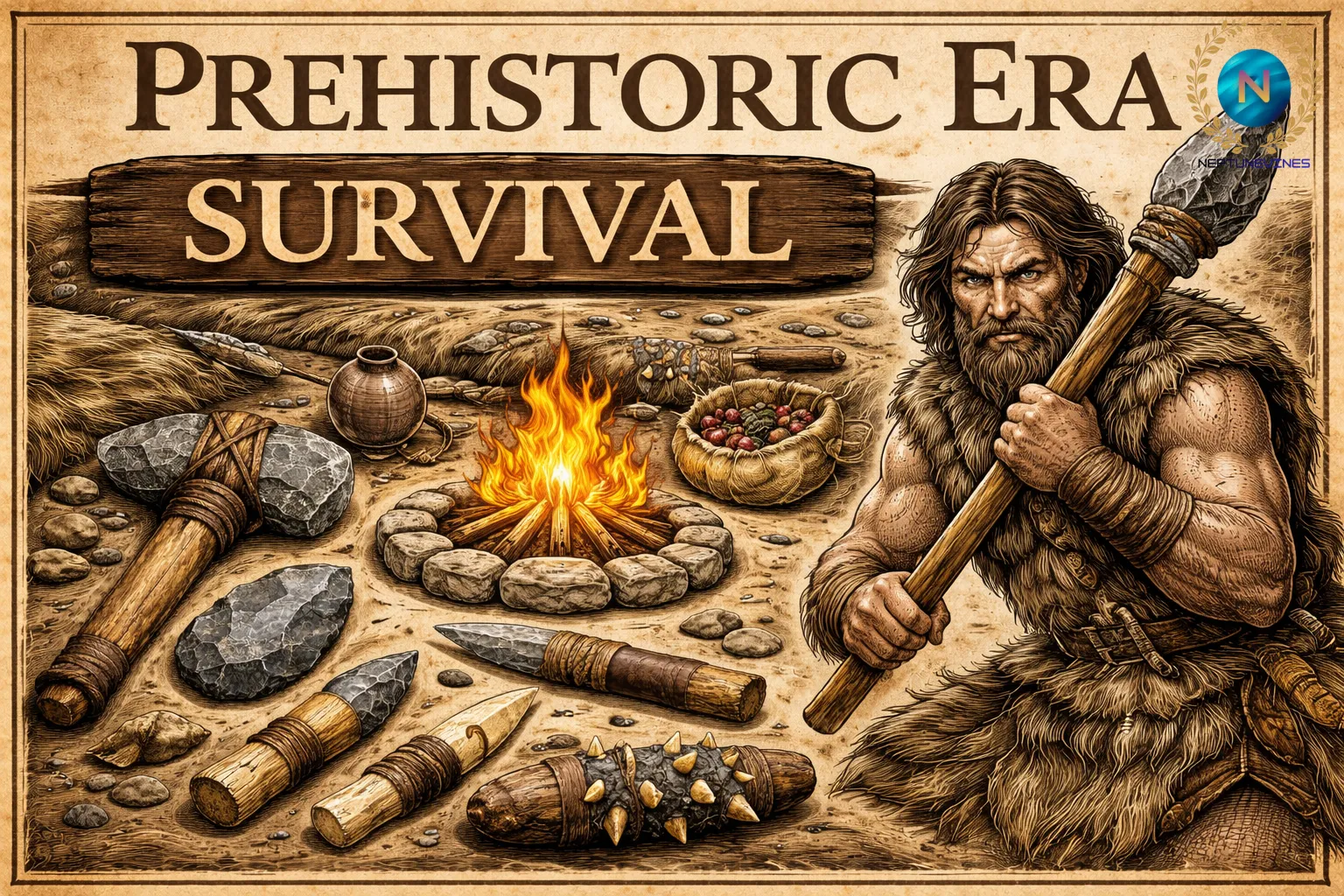
 image of Prehistoric Weapons (This is an AI generated Image not real prehistoric weapons)
UPSC Previous Year Questions – Prehistoric Era
1. UPSC Prelims (Example)
Which one of the following is the earliest known site of the Palaeolithic Age in India?
A. Bhimbetka
B. Mehrgarh
C. Lothal
D. Harappa
Answer: A – Bhimbetka
Explanation: The Bhimbetka rock shelters in Madhya Pradesh contain evidence of early human habitation and prehistoric cave paintings.
2. UPSC Mains – GS Paper 1 (2020)
Question:
How did the Neolithic Revolution impact early Indian societies, particularly in terms of agriculture and social structures?
This question tests:
-
Shift from hunter-gatherer → agriculture
-
Emergence of permanent settlements
-
Domestication of animals
-
Development of pottery, weaving, and tools.
3. Conceptual PYQ-type Question
A celt from the Neolithic period refers to what?
A. Tomb
B. House
C. Tool
D. Urn
Answer: C – Tool (polished stone axe).
4. Tool-based Question
‘Microliths’ used by early humans were:
A. Coins
B. Stone tools
C. Clothes
D. Earthen pots
Answer: B – Stone tools (very small blades used in Mesolithic period).
5. Statement-based Question (Rock Art)
Consider the following statements regarding prehistoric rock art:
-
Rock paintings in India were first discovered by Archibald Carlleyle.
-
Bhimbetka caves contain nearly 400 painted rock shelters.
-
Upper Palaeolithic period shows artistic human and animal figures.
Which of the statements are correct?
A. 1 only
B. 1 and 2
C. 1 and 3
D. 1, 2 and 3
Answer: D – All correct.
Typical Themes UPSC Asks from Prehistoric Era
1. Stone Age classification
-
Palaeolithic (Old Stone Age)
-
Mesolithic (Middle Stone Age)
-
Neolithic (New Stone Age)
2. Tools
-
Hand axe
-
Chopper
-
Microliths
-
Polished stone tools
3. Sites
Very high probability in UPSC:
-
Bhimbetka
-
Hunsgi
-
Kurnool caves
-
Bagor
-
Burzahom
-
Mehrgarh
4. Lifestyle changes
-
Discovery of fire
-
Domestication of animals
-
Beginning of agriculture
-
Permanent settlements.